

What if the strongest case for sales automation starts with the work your team can’t get to? Manual prospecting and follow-up take time away from selling, but expected returns can be difficult to estimate before implementation. A defensible business case for sales automation platform investment connects specific workflow gaps to measurable outcomes, without treating projected gains as guarantees.
Start by setting a credible baseline: how much time goes to finding prospects, verifying contacts, and sending follow-ups, and where delays or missed steps occur. Then align stakeholders on which measures matter, what adoption requires, and what guardrails should guide implementation. A clear value model helps teams weigh potential benefits against the effort and operational changes involved.
This guide explains how to build that case and evaluate platform fit. You’ll define the workflow problem, set success criteria, and use a disciplined buying plan to compare capabilities with real team needs. For teams evaluating end-to-end outbound workflows, we’ll also look at how Seasely connects target-company discovery and qualification with verified decision-maker emails, personalized automated outreach, and campaign optimization.
Key Takeaways
- Build a business case for sales automation platform investment by linking a documented workflow problem to expected value and evidence.
- Establish a baseline for activity, handling time, workflow completion, and relevant pipeline measures before estimating potential impact.
- Compare options against consistent criteria, including workflow coverage, data quality, integrations, governance, adoption, and reporting.
- Use a bounded pilot to test adoption, data quality, workflow efficiency, and qualified pipeline indicators before making a broader decision.
- Present assumptions, investment categories, pilot evidence, and unresolved risks alongside projected benefits.
Why Build a Business Case for a Sales Automation Platform?
A business case turns a general desire to “save time” into a decision the team can test. It documents the sales workflow that needs attention, the investment required to change it, the value the team expects, and the evidence that will show whether the change worked. This is more useful than a feature list because it starts with how prospecting and outreach happen today.
Sales force management systems (SFA) support sales activities through technology, often within a broader CRM environment. For a practical case, narrow that broad category to the work at hand: finding target companies, qualifying them, verifying decision-maker contact details, and preparing initial outreach. Seasely connects these outbound steps, allowing teams to assess an end-to-end workflow rather than a single task.
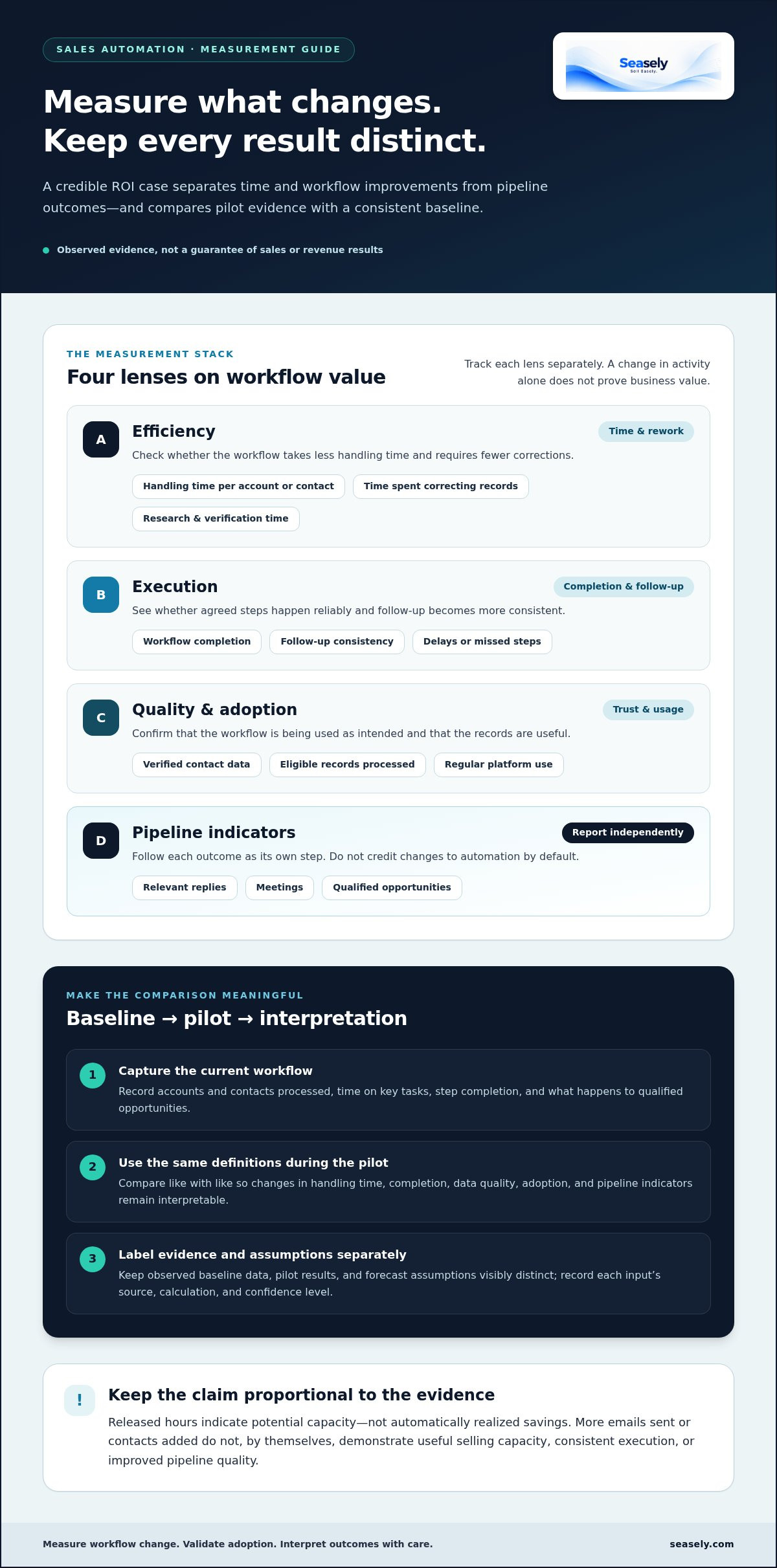
Activity volume alone is weak evidence. More emails sent or more contacts added doesn’t show whether reps gained useful selling capacity, execution became more consistent, or pipeline quality changed. Track those as distinct value areas. Measure time released and how reps use it, review whether key steps happen reliably, and monitor qualified pipeline indicators separately. This keeps a modeled operational benefit from being presented as a proven sales outcome.
“A business case for sales automation is a documented model of how a defined workflow change may create measurable value, supported by evidence, not a guarantee of sales or revenue results.”
Which sales workflows create a case for automation?
Start with recurring work that consumes time or introduces avoidable variation. Map each step, who performs it, how long it takes, and where work pauses or gets repeated. Focus on one team, segment, or outbound motion so the baseline stays specific.
- Prospect research and company qualification: record the time spent identifying accounts and checking fit.
- Contact verification and initial outreach: note rework caused by inaccurate details or manual preparation.
- Handoffs and follow-up: identify duplicate entry, unclear ownership, delayed next steps, and incomplete records.
These observations define the problem before software enters the discussion. Prioritize bottlenecks that occur often and affect a clear operating goal, rather than automating a task simply because it can be automated.
Which stakeholders need to agree on the case?
Sales leadership should define the intended operational gain, such as more rep capacity for qualified conversations or more consistent follow-up. Finance should review assumptions, investment categories, and the reporting method. Revenue operations can map current processes and establish comparable measures. Include relevant technical and compliance owners when workflow design touches systems, data handling, or outreach controls.
Ask each stakeholder to agree on the baseline, the measures that matter, and what evidence would change the decision. This prevents one group from judging success by activity volume while another expects pipeline impact. It also surfaces adoption requirements early, before a pilot is mistaken for a technology-only change.
How to Measure Sales Automation ROI Without Overpromising
ROI depends on the quality of the inputs. Before estimating value, capture a representative baseline for the outbound workflow: how many accounts and contacts the team processes, how long key tasks take, how often workflow steps are completed, and what happens to qualified opportunities. Use the same definitions during a pilot so the comparison stays meaningful.
Separate value into distinct categories. Released hours show potential capacity, not automatically realized savings. Usable capacity reflects whether reps apply that time to valuable work. Workflow quality includes measures such as completion and data accuracy. Pipeline measures, including qualified opportunities, belong in the model too, but changes should not be credited to automation by default.
Which sales automation metrics belong in the model?
Choose measures that map directly to the workflow being evaluated. For example, track research and verification time per qualified account or decision-maker, then compare it with the baseline. Measure outreach completion, relevant replies, meetings, and qualified opportunities as separate steps. This sequence can reveal where performance changes without treating every activity as equivalent.
- Efficiency: handling time per account or contact, plus time spent correcting records.
- Execution: workflow completion and follow-up consistency.
- Quality and adoption: verified contact data, eligible records processed, and regular platform use.
- Pipeline indicators: relevant replies, meetings, and qualified opportunities, reported independently.
Activity totals can help explain throughput, but they don’t establish business value on their own. Pair them with quality and outcome measures, and check whether the team is using the workflow as designed.
How should teams label assumptions and attribution?
Keep observed baseline data, pilot results, and forecast assumptions visibly distinct in one model. For each input, record its source, calculation, and confidence level. If adoption, time savings, or conversion is uncertain, use conservative, expected, and higher-case scenarios rather than a single precise-looking forecast.
Apply the same discipline to attribution. Note other changes during the evaluation, such as a revised target segment or messaging, that may affect replies or opportunities. Treat pipeline movement as evidence to investigate, not proof of cause, unless the measurement design supports that conclusion.
“Modeled ROI depends on measured inputs and a clear attribution method; it describes a scenario, not a guaranteed result.”
List the full investment alongside modeled benefits. Include subscription, onboarding, integration, administration, and enablement, using figures that match the proposed scope. A simple framework is: (modeled benefits − total investment) ÷ total investment. Define what counts as a benefit and use a consistent time period for both sides of the calculation. This makes the business case for sales automation platform investment transparent, even when some inputs remain uncertain.
Seasely’s sales automation platform combines prospect discovery, contact verification, personalized email sending, and campaign optimization. Assess those capabilities against the same baseline and ROI measures.
Compare Sales Automation Options Against the Business Case
Use the same requirements to assess every approach. A point solution may handle one task well but leave handoffs between research, verification, and outreach. Existing-system workflows can reduce tool sprawl but may not cover every outbound step. An end-to-end platform can connect more of the process, while still requiring evaluation of data quality, governance, and team adoption. Compare actual workflow coverage, not feature counts.
| Evaluation area | Questions to record |
|---|---|
| Workflow coverage | Which steps are supported, and where does work remain manual? |
| Data quality | How are target accounts qualified and decision-maker email addresses verified? |
| Integration needs | Which existing systems, data flows, or handoffs are affected? |
| Governance | How will the team oversee personalization and sending practices? |
| Adoption | Who owns setup and daily use, and what training or process changes are needed? |
| Reporting | Can the approach report on workflow completion, quality, and relevant outcomes? |
Score each option against the requirements established in the business case for sales automation platform investment. Note the evidence, open questions, and manual work that remains. A strong comparison makes trade-offs visible instead of assuming broader automation automatically means a better fit.
What capabilities matter for an outbound sales case?
Trace an account from discovery to campaign review. Check how target companies are found and qualified against the team’s sales criteria. Then assess how decision-makers are identified and email addresses verified. Finally, examine whether personalization, automated sending, and campaign optimization operate as connected steps or require separate tools and repeated data entry.
This end-to-end view reveals gaps that a feature checklist can miss. For a more detailed workflow lens, see this guide to evaluating the complete AI outbound sales platform workflow.
How can teams compare workflow fit and operational risk?
Map each option to current systems, process owners, and reporting needs. Identify who maintains target criteria, reviews contact data, approves messaging, and monitors campaign performance. Review how the workflow supports relevant personalization and responsible sending practices, including the team’s approach to protecting domain reputation. Treat these as operational evaluation points, not assumed capabilities.
Then document what remains outside the system. For example, a tool might automate contact discovery while reps still move records manually into another workflow. That handoff has an owner, a time cost, and a potential failure point. Capture it in the comparison rather than treating it as a minor implementation detail.
- Point solutions: assess depth on the task they address and the handoffs they leave.
- Existing-system workflows: assess fit with current processes and any coverage gaps.
- End-to-end platforms: assess how well connected steps match the team’s requirements and governance.
The preferred option is the one whose verified coverage, operating requirements, and remaining gaps best fit the case, not simply the one with the longest capability list.
How to Pilot Sales Automation and Prove the Case
A pilot tests whether a proposed workflow fits the team and produces evidence for a wider decision. Keep the scope bounded: select one team, segment, or outbound workflow, and document its baseline before launch. Define which users and records are included, which steps the platform will support, and what remains manual. Avoid changing several parts of the sales motion at once, or it becomes harder to interpret the results.
Set success thresholds before the pilot begins. Include adoption, data quality, workflow efficiency, and qualified pipeline indicators. Assign an owner and data source to each measure, set review dates, and agree on conditions to stop, adjust, or expand. Thresholds should fit the team’s baseline and goals, not a generic benchmark.
What should a sales automation pilot measure?
Compare the pilot with its baseline using consistent definitions and reporting periods. Pair operational outputs with quality signals. For an outbound workflow, track research and verification time alongside contact accuracy, completed follow-up steps, relevant replies, and qualified opportunities. Email volume alone cannot show whether outreach reached the right people or improved the process.
- Adoption: whether participants use the agreed workflow consistently.
- Data quality: whether account and contact records meet the team’s criteria.
- Efficiency: how handling time and workflow completion compare with baseline.
- Quality indicators: how relevant replies and qualified opportunities change, interpreted with care.
Keep an exception log. Record manual corrections, skipped steps, and rep feedback. These notes can explain why a metric moved and expose friction that a dashboard may miss.
Which risks and adoption barriers belong in the plan?
Assign named owners for data quality, sequence review, sending controls, and escalation. Before launch, define how the team will check personalization for relevance, maintain human oversight, and respond to engagement signals that weaken. Establish clear boundaries for automated steps and situations that require a rep’s judgment. Review domain reputation as an operational safeguard, not an assumed outcome.
- Train participants on workflow steps, personalization review, and exception handling.
- Set a process for pausing or revising outreach if quality or engagement indicators deteriorate.
- Review adoption at each checkpoint and distinguish usability issues from lack of fit.
At each review date, compare results with the pre-agreed thresholds. Stop if material safeguards or data-quality requirements fail. Adjust when the workflow shows promise but execution needs correction. Expand only when adoption, quality, and efficiency evidence support the next scope. Pipeline indicators can inform that decision, but they don’t guarantee future results. This evidence-based gate turns the pilot into a practical test of the business case for sales automation platform investment.
See how Seasely’s AI outbound sales platform supports a connected prospecting and outreach workflow.
Turn the Business Case Into a Sales Automation Decision
A useful business case ends with a decision, not just an ROI estimate. Summarize the problem, the teams and workflows affected, the baseline evidence, and the change under consideration. Then show the investment categories, modeled outcomes, assumptions, pilot findings, and unresolved risks together. This gives decision-makers a clear view of both the case for change and the conditions needed to manage it.
What belongs in a one-page sales automation business case?
Keep the summary concise enough to review, but specific enough to act on. State what decision you need, who owns the work, and how progress will be measured. Separate observed evidence from projections, and include safeguards rather than presenting benefits alone.
- Problem and scope: name the affected team, target workflow, and measurable friction.
- Baseline and value model: show current measures, modeled value, investment inputs, and scenario assumptions.
- Evidence and risks: summarize pilot results, data quality, adoption, remaining gaps, and safeguards.
- Decision and ownership: specify the approval or next step, accountable owners, reporting cadence, and next review milestone.
Keep the measures traceable. A reviewer should be able to see which results were observed, which were modeled, and what evidence would change the recommendation. Record unresolved risks plainly, with an owner and a plan to review them.
When does an outbound platform fit the case?
An end-to-end outbound platform is worth evaluating when fragmented steps create measurable delays or repeated manual work across prospect discovery, qualification, contact verification, personalization, and sending. Fit depends on the approved requirements: map each capability to a defined workflow need, then compare it with pilot measures and safeguards. Connected steps matter only if they address the friction the team documented.
Seasely supports B2B prospect discovery and qualification, identifies and verifies decision-maker email addresses, and automates personalized outreach and campaign optimization. Evaluate these capabilities against your adoption, data-quality, efficiency, and reporting requirements rather than assuming they will produce a particular pipeline or revenue outcome.
Before approval, make the requested decision explicit. It might be permission to proceed to a bounded pilot, continue with a specific option, or defer until a risk is resolved. Set the owner for each next action and the milestone when stakeholders will review evidence again. That closes the gap between analysis and execution.
Explore Seasely’s AI outbound sales platform as part of your evaluation.
Make the Next Step Evidence-Led
Turn your evaluation into a decision your team can revisit as evidence develops. Keep the scope clear, name who owns each measure, and set a review point before expanding the workflow. This creates room to refine the process when adoption, data quality, or results differ from expectations.
A sound business case for sales automation platform investment should guide action without pretending to remove uncertainty. Seasely brings target-company discovery and qualification together with decision-maker email verification, personalized automated outreach, and campaign optimization. Assess these capabilities against your team’s agreed criteria and pilot measures.
To evaluate a connected B2B outbound workflow, explore Seasely’s AI outbound sales platform. Use your agreed criteria and pilot measures to decide whether it fits your team’s next step.
Frequently Asked Questions
How do you calculate ROI for a sales automation platform?
Calculate ROI by subtracting total investment from modeled benefits, then dividing the difference by total investment. For a business case for sales automation platform investment, define benefits carefully: released capacity counts as value only if the team can put it to productive use, while pipeline changes need a defensible attribution method. Keep observed results separate from forecasts, and show conservative and expected scenarios when key assumptions remain uncertain.
What metrics should be included in a sales automation business case?
Choose metrics that reveal whether the workflow is working, not just whether the platform is active. Track time spent per account, qualified-contact accuracy, completed follow-up steps, rep adoption, and exception rates. Add outcome indicators such as relevant replies or qualified opportunities, but compare them with a suitable baseline and account for changes in audience or messaging. Segment results by team or account type to identify where the process fits best.
How long should a sales automation pilot run before a decision?
Run the pilot long enough to observe the complete workflow and collect enough comparable data to assess the agreed measures. There’s no universal duration: the right period depends on outreach volume, workflow frequency, and how long it takes to observe downstream indicators. Set review points in advance, and avoid deciding from an early activity spike. If the pilot hasn’t produced enough evidence, extend or adjust it rather than overstating certainty.
Can sales automation improve pipeline without increasing headcount?
It may help a team use existing capacity more effectively, but it can’t guarantee pipeline growth. Automation can reduce repetitive steps and support consistent outreach, giving sales representatives more room for tasks that require judgment. Whether that affects pipeline depends on targeting, message relevance, follow-through, and market response. Track both capacity use and qualified pipeline indicators so the team can tell whether time released is translating into useful sales work.
What costs should a sales automation business case include?
Include more than the software subscription. Account for onboarding, integrations, internal administration, training and enablement, and any added tools or process work required to run the workflow. Estimate internal effort as well as direct expenses, and identify which costs recur versus occur during setup. For a fair comparison, use the same time horizon and scope for each option, and document assumptions instead of masking uncertain inputs.
How do you get finance and sales leadership aligned on automation?
Give both groups a shared decision document before asking for approval. Sales leadership can define the workflow problem and operational measures; finance can validate the investment assumptions and reporting approach. Agree on metric definitions, evidence sources, ownership, and what result would justify continuing, adjusting, or stopping. A short review meeting focused on those points helps surface different expectations early and prevents each team from judging success by a different standard.
Can sales automation affect email deliverability or domain reputation?
Yes. Automated outreach can affect deliverability and domain reputation if contact data is poor, targeting is irrelevant, or sending practices create negative engagement signals. Build safeguards into the workflow: verify contact details, review personalization for relevance, monitor engagement and delivery indicators, and assign an owner to respond to deterioration. Automation supports execution, but human oversight remains important for message quality, audience selection, and decisions to pause or revise a campaign.


