

A strong sales software case can start with hours saved and fewer handoffs, not a forecast of new revenue. That’s the practical challenge in justifying investment in sales software: teams need to connect spend to business outcomes while accounting for adoption, implementation effort, and the tools already in the stack. A projected revenue lift alone won’t make the case credible.
Measure what the software can change directly. Track workflow effort, tool overlap, and the quality of prospecting steps before estimating downstream impact. This gives decision-makers a clearer view of the investment and the assumptions behind it.
In this article, you’ll learn how to build a defensible ROI model, compare a new platform with current processes and alternatives, and set success measures that limit evaluation risk. We’ll also look at how combining target discovery, qualification, verified decision-maker contacts, and automated outreach can make workflow gains easier to assess. The result is a practical investment case grounded in observable measures, realistic expectations, and a clear path to review.
Key Takeaways
- Start by identifying the workflow improvement you want to fund, then map the work and tools involved today.
- When justifying investment in sales software, calculate ROI against the full investment, including setup, integration, training, and ongoing administration.
- Compare the proposed platform with current processes and existing tools using consistent criteria, not feature lists alone.
- Set a baseline and define pilot measures for workflow time, qualified targets, verified contacts, and outreach activity.
- Assess whether Seasely’s combined prospect discovery, qualification, contact verification, and automated outreach fit the workflow you’re evaluating.
Why Justifying Investment in Sales Software Starts with the Current Workflow
Start with the decision leadership needs to make: should the team improve a specific sales workflow? A software purchase is a means, not the outcome. Justifying investment in sales software requires showing where the current process creates effort, delay, or inconsistent execution, then explaining how a proposed change could address those issues. A clear baseline also helps separate measurable process gains from hoped-for revenue results.
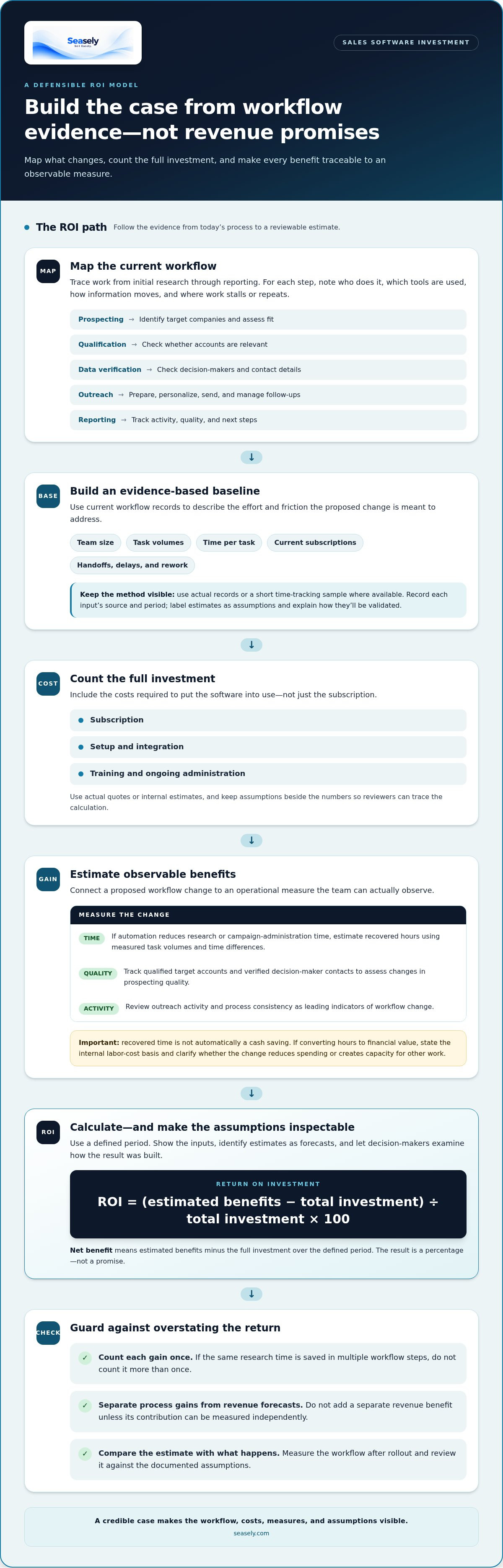
Map the workflow from initial research through reporting. Record who completes each step, which tools they use, where information moves, and where work stalls or repeats:
- Prospecting: How does the team identify target companies and decide whether they fit?
- Qualification: What checks determine whether an account is relevant?
- Data verification: How are decision-makers and contact details checked?
- Outreach: Who prepares, personalizes, sends, and manages follow-up messages?
- Reporting: How does the team track activity, quality, and next steps?
This map turns a broad request for “sales software” into a defined operational problem. It also shows whether the main constraint is manual research, disconnected systems, unclear ownership, or a step without a consistent process.
Which sales workflow costs belong in the business case?
Build the baseline from visible expenses and operational effort. List current software subscriptions, including tools with overlapping capabilities. Then estimate team hours spent on repetitive research, contact checks, campaign administration, and reporting. Use actual records or a short time-tracking sample where available. Document the method rather than presenting an unsupported estimate as fact.
Capture friction that a license invoice won’t show. Note handoffs, delays while data is checked, and rework caused by incomplete or inconsistent records. Describe these effects in operational terms, such as a campaign waiting for contact validation. Keep them visible without assigning an unverified dollar value. This gives leadership a fuller comparison point for the investment case.
Which business outcomes can software realistically influence?
Separate leading indicators from lagging outcomes. Qualified target accounts, verified decision-maker contacts, time spent on research, and outreach activity can show whether the workflow is changing. Revenue and closed deals come later and depend on factors beyond the software, including execution, market fit, and how outcomes are measured.
Connect each proposed workflow change to a specific operational outcome. Less repetitive research may free sales capacity for follow-up; verified contacts may improve data quality; a consistent outreach process may make campaign activity easier to review. These are testable links, not promises of revenue. The Customer Relationship Management (CRM) approach also centers on organizing customer information and using it to support sales processes, which helps frame software as part of a wider operating method.
For outbound workflows, assess how target discovery, qualification, contact verification, and outreach fit together rather than judging isolated features. The AI outbound sales platform evaluation guide can help structure that review. With a documented process, costs, and measurable indicators, leadership can evaluate a specific improvement before treating future revenue as part of the case.
How to Calculate Sales Software ROI Without Overstating the Return
A useful ROI model makes its assumptions easy to inspect. Use this formula:
ROI = (estimated benefits − total investment) ÷ total investment × 100
Here, net benefit means estimated benefits minus the full investment over a defined period. The result is a percentage, not a promise. If benefits are uncertain, show the inputs and label the result as a forecast. That gives leadership a way to challenge assumptions and compare the estimate with what the team measures after rollout.
What inputs make a sales software ROI estimate credible?
Start with evidence from the current workflow: team size, task volumes, and time per task. Record where each input came from and the period it covers, such as time logs or campaign records. If you use an estimate because tracking is incomplete, identify it as an assumption and explain how you’ll validate it.
Then capture the full investment: subscription, setup, integration, training, and ongoing administration. Use actual quotes or internal estimates rather than placeholder figures. Keep assumptions beside the numbers so reviewers can trace the calculation.
Estimate benefits from changes the team can observe. For example, if automation reduces time spent on research or campaign administration, calculate the hours recovered using measured task volumes and time differences. If you convert those hours into a financial value, state the internal labor-cost basis. Also clarify whether the change reduces cash spending or creates capacity for other work. Recovered time isn’t automatically a cash saving.
Prevent double counting. If the same saved research time appears in two workflow steps, count it once. If improved process consistency is expected to support pipeline, don’t add a separate revenue benefit unless you can measure its contribution independently. Keep operational gains distinct from revenue forecasts.
How should teams model uncertainty and payback?
Build conservative, expected, and upside scenarios from explicit assumptions. Adoption is one useful variable: estimate what changes if only part of the team uses the workflow consistently, then compare that with broader adoption. Vary other uncertain inputs, such as time saved per task, only when you can explain the basis for each scenario.
Set the baseline and measurement period before implementation. Compare measured benefits with investment over the same period, and show when cumulative net benefits would offset cumulative costs. That is more informative than dividing the license cost by a single projected revenue figure, especially when setup effort and adoption affect the timing.
Present the headline ROI beside the assumptions that drive it, plus the conservative scenario and the measures you’ll track. For an outbound workflow, those measures might include research time, qualified target companies, verified decision-maker contacts, and outreach activity. Teams assessing an integrated process can evaluate the Seasely AI outbound sales platform against those measures. A transparent model makes justifying investment in sales software a testable business case, not a claim that software alone will produce revenue.
Compare Sales Software with the Status Quo, Not Just a Feature List
A feature list shows what a platform can do. It doesn’t show whether those capabilities improve the way your team works. For a credible comparison, assess the proposed platform against three options: the current manual workflow, the tools already in use, and doing nothing. This makes the trade-offs visible, including the effort required to change processes and the cost of leaving friction in place.
Apply the same criteria to each option:
- Workflow coverage: Which steps are supported, and where will people still need to work elsewhere?
- Data quality: How does each approach support accurate, usable prospect and contact information?
- Adoption effort: What changes for the people who will use the workflow?
- Integration needs: How must information move between the platform and existing systems?
- Measurement: Can the team track the process outcomes it needs to assess?
Compare like with like. If a platform combines capabilities currently handled by separate tools, list which tools could be reduced or retired, but don’t count consolidation as a saving by itself. Count a subscription saving only if a budget changes. Count recovered effort only if the team’s measured time or workload changes. A capability that overlaps with an existing tool may simplify work, or it may add another system to manage.
When does an integrated sales workflow make sense?
Look for repeated handoffs between account research, qualification, contact data, and outreach. A connected workflow may help when people repeatedly transfer records or re-enter information. But not every step should be automated. Target selection, message judgment, and decisions about account fit may still need human review. Compare consolidated and separate tools based on workflow fit, data handling, and operational effort, not on the assumption that fewer tools always create more value.
For example, a team could map which tasks follow a consistent sequence and which depend on context or approval. Repeatable research and data checks may be candidates for structured support; exceptions and final decisions may remain with the sales team. The comparison should show where the platform supports the process and where human ownership stays necessary.
How can buyers assess adoption and integration risk?
Map the proposed workflow to current roles, approval steps, and systems before estimating benefits. Identify who owns records, who reviews outreach, what training users need, and what data governance practices must carry across. Then define practical adoption measures, such as whether users complete agreed workflow steps and maintain required records. Low usage can erase projected process gains, even when the feature set appears to fit.
Include the work of introducing the change in the comparison, not as an afterthought. A simpler process may still require training or integration effort. Weigh those demands against the workflow coverage and measurement the platform enables. This makes justifying investment in sales software a decision about fit, trade-offs, and execution, rather than a contest to select the longest feature list.
Build a Sales Tech Business Case with Measurable Pilot Criteria
A pilot turns a software proposal into a controlled evaluation. Before launch, record the baseline for the workflow in scope: time spent on key tasks, qualified target accounts, verified contacts, and outreach activity. Use the same definitions and collection method throughout the pilot so the team can compare results without shifting the measurement rules midway.
Keep the scope narrow enough to review clearly. Specify which team, workflow steps, and processes are included, then name an owner responsible for data capture and issue tracking. Set a review cadence that gives participants time to use the process and leadership a regular view of progress. Document assumptions, dependencies, and measurement limits before the first results arrive.
Which pilot metrics should sales leaders track?
Track completion and quality at each relevant workflow stage, not just total activity. For example, note whether target accounts meet agreed qualification criteria, whether decision-maker contacts are verified, and whether outreach steps are completed as intended. Pair these measures with active use of the agreed workflow and the manual work that remains. Activity volume alone can rise without showing better process execution.
Choose a small set of measures that answer the investment question:
- Workflow: Time required for defined tasks and steps completed without rework.
- Quality: Qualified targets and verified contacts, using consistent criteria.
- Adoption: Use of the agreed process by the participating team.
- Execution: Outreach activity and any manual steps still required.
If you include response or conversion measures, define what counts and how the result will be attributed before the pilot begins. Report operational evidence separately from projected pipeline or revenue. This keeps observed changes distinct from outcomes that may depend on timing, market conditions, sales execution, or other factors.
How should the investment proposal address risk?
Make dependencies explicit. Identify the data quality, process ownership, user participation, and system access the pilot relies on. Then decide in advance what would trigger a pause, a revision, or a recommendation to continue. Thresholds should reflect the baseline and business need, not a benchmark invented to make the proposal look stronger.
If adoption falls short, examine whether the workflow is clear, training is adequate, or ownership is missing before interpreting the result. If operational measures don’t improve, review where time or rework remains and whether the proposed process addresses that point. Document changes so the team can distinguish a revised test from the original evaluation.
A defensible pilot makes justifying investment in sales software a reviewable decision: stakeholders can see what was tested, what changed, and what remains uncertain. For a team assessing prospect discovery, qualification, verified contacts, and automated outreach, evaluate Seasely’s outbound workflow against the pilot criteria you’ve set.
Where Seasely Fits in a Sales Software Investment Decision
Once the business case defines the workflow gap and how to measure it, assess each platform against those requirements. Seasely is an AI-powered B2B outbound sales platform that brings target-company discovery, qualification, verified decision-maker email addresses, and automated outreach into one workflow. That makes it relevant for teams evaluating prospecting steps that currently depend on separate tools or repeated manual handoffs.
The fit question is specific: do these capabilities address the documented work, and can the team measure the operational difference? Map each capability to a baseline measure, such as time spent identifying accounts, completion of qualification checks, contact verification, or campaign administration. Treat any expected gain as a hypothesis to test, not a promised result.
Which parts of an outbound workflow does Seasely support?
Seasely supports several connected prospecting activities. It discovers and qualifies target companies, provides verified decision-maker email addresses, and supports personalized automated outreach. Campaign optimization helps teams refine their outreach based on campaign activity. Assess these capabilities against defined workflow requirements without assuming every task should be automated.
- Discovery and qualification: Compare target-company selection with the team’s sales criteria.
- Contact data: Track verified decision-maker contacts as a process measure.
- Outreach: Assess personalized automated sending against existing campaign steps.
- Optimization: Review whether campaign adjustments support the team’s measurement plan.
Automation can support consistent execution, but it can’t ensure that a target is ready to buy or that outreach will convert. Sales outcomes still depend on factors such as market fit, message relevance, and team execution. Keep those outcomes separate from direct workflow measures in the investment case.
How can a team assess fit before committing?
Use the documented business case as an evaluation checklist. For every identified gap, name the relevant Seasely capability, the process owner, and the measure that would indicate progress. Then review how the platform fits the team’s outbound process, including who sets qualification criteria, reviews messaging, and monitors campaign activity. This connects product fit to operating responsibilities rather than feature volume alone.
Also make remaining work visible. Note which decisions still require human judgment and which steps continue outside the platform. Compare that operating model with the current workflow so the team can assess expected effort, overlap, and adoption needs. If a measure cannot be observed during the evaluation, don’t treat it as proven value.
This disciplined approach keeps justifying investment in sales software grounded in a defined use case. Teams can explore Seasely’s outbound platform against their documented gaps and success measures. The decision should rest on fit and evidence the team can review, not an assumption that automation alone will produce pipeline or revenue.
Turn Your ROI Case into a Practical Next Step
A strong business case should lead to a decision the team can act on, not a forecast that depends on untested assumptions. Use your documented workflow gaps and pilot measures to assess whether a platform fits the work your sales team needs to improve. That keeps justifying investment in sales software grounded in operational evidence while leaving revenue outcomes open to measurement.
For outbound teams, that assessment can include how automated target-company discovery and qualification, verified decision-maker email addresses, personalized automated outreach, and campaign optimization fit the existing process. Evaluate each capability against a defined need, and keep the distinction clear: automation can support consistent execution, but it can’t guarantee sales or revenue.
Evaluate Seasely for your outbound sales workflow against your team’s priorities and success measures. Start with a defined workflow gap and the measures you’ll use to assess fit.
Frequently Asked Questions
Is sales software ROI measurable?
Yes, sales software ROI is measurable when a team defines a baseline, consistent metrics, and a measurement period. For example, compare the time required to process similar prospect lists before and after a workflow change. Revenue is harder to attribute because market conditions, sales execution, and offer fit also affect results. Keep observed changes separate from projections, and record the assumptions behind each financial estimate.
Can sales software improve productivity without increasing headcount?
It can help a team reduce repetitive tasks or manage more workflow with existing staff, but the effect depends on adoption and process design. Track whether time saved on research or administration is actually available for another task, such as follow-up. That capacity may improve productivity without changing headcount. Don’t count estimated hours as cash savings unless spending or staffing changes as a result.
How much data do you need to justify sales software?
There’s no universal minimum. Start with enough information to describe workload, time spent, current costs, and the outcomes relevant to the decision. Use a period that represents normal operations, and flag gaps or seasonal changes that could affect comparisons. If records are incomplete, show a range rather than false precision. A limited evaluation can help fill specific evidence gaps before a broader commitment.
What happens if sales representatives do not adopt the software?
Low adoption can limit the expected benefit because representatives may continue using old processes alongside the new system. Before rollout, make ownership clear and track whether people use the agreed workflow, not just whether they log in. If participation is low, investigate training, usability, and fit with existing responsibilities. The issue may be fixable, but capability alone won’t improve a process that the team doesn’t use.
Can sales software replace a CRM?
Not necessarily. A CRM commonly organizes customer and opportunity records, while other sales tools may support prospect discovery, contact verification, or outreach. Some platforms work alongside a CRM rather than replacing it. Before making a decision, map which system owns each record and where updates need to flow. Include the impact of duplicate entry, integration work, and changes to existing sales processes in the evaluation.
How should finance teams evaluate sales software payback?
Finance teams should examine the full investment, the source of each benefit assumption, and when benefits may occur. Separate recurring subscription and operating expenses from one-time setup effort. Test how the estimate changes if adoption is slower or process improvements take longer to appear. Treat projected pipeline as a forecast, not realized revenue, and compare it with operational evidence gathered during the evaluation.
Is sales software worth it for a small sales team?
Team size alone doesn’t determine whether it’s worthwhile. A small team may find value if repetitive prospecting work limits time for other responsibilities, but setup and ongoing use still require effort. Compare the proposed workflow with the current process, including who will own it and what work remains manual. A focused evaluation can help reveal whether the tool addresses a real bottleneck before expanding its use.


