

What if the hours sales automation saves never reduce costs or produce more revenue? That’s the gap between time reclaimed and measurable return. It’s why how to calculate ROI of sales automation starts with a consistent baseline, not a headline efficiency claim.
Software costs are usually visible. Benefits take more care to measure. A rep may spend less time researching prospects or sending follow-ups, but that time creates financial value only when it supports a defined outcome, such as lower operating costs or additional sales activity. Revenue can also be difficult to attribute when several tools and campaign changes affect the same results.
This guide provides a transparent ROI formula, explains how to choose defensible inputs, and separates realized savings from capacity released for other work. You’ll also learn how to set a baseline, include implementation and ongoing costs, and track results after launch. The goal is a business case based on incremental value, not optimistic assumptions, whether you’re assessing a connected workflow for prospect discovery, verification, and personalized outreach or reviewing an existing automation setup.
Key Takeaways
- Learn how to calculate ROI of sales automation with a formula that compares measurable benefits against total investment.
- Distinguish realized savings and incremental gross profit from rep capacity freed for other work.
- Compare manual and automated prospecting using equivalent cohorts, criteria, and outcome measures.
- Build conservative, expected, and upside scenarios to identify which assumptions have the greatest effect on ROI.
- Use your findings to identify workflow bottlenecks and assess automation options by coverage, data quality, and measurement.
What Sales Automation ROI Measures, and What It Does Not
Sales automation ROI is the net measurable financial benefit attributable to an automation investment, divided by the total cost of that investment over the same period. It applies the general purpose of Return on Investment (ROI) to a sales workflow: compare value gained with resources spent over a consistent measurement window.
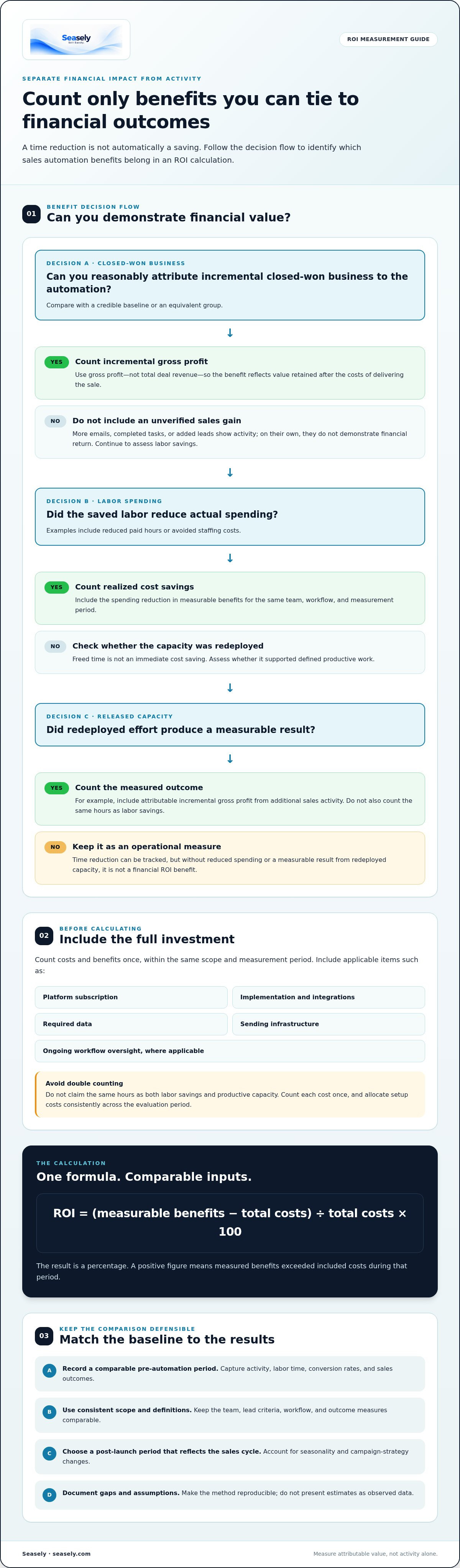
This definition separates three outcomes that are often blurred together: incremental gross profit, realized cost savings, and capacity released for other work. Include only benefits that can be measured and reasonably connected to the automation. More emails sent, tasks completed, or leads added may indicate higher activity, but they do not demonstrate a positive financial return on their own.
Which benefits can count toward sales automation ROI?
Count incremental gross profit from closed-won business when you can attribute the gain to automation by comparing it with a credible baseline or equivalent group. Use gross profit rather than total deal revenue so the benefit reflects the value retained after the costs of delivering the sale.
Count labor savings when they reduce actual spending, such as paid hours or avoided staffing costs. If automation frees reps to handle more valuable work, treat that time as released capacity, not an immediate cost saving. It can support ROI when the redeployed effort produces a measurable result, such as incremental gross profit. Avoid counting both the value of the same saved hours and the resulting sales benefit.
Time studies can help quantify changes in manual prospect research, email verification, and administrative work. For example, compare the time spent per qualified prospect before and after automation. A connected workflow for discovering and qualifying target companies, verifying decision-maker email addresses, and supporting personalized outreach can make these process changes easier to track. The time reduction is an operational measure; its financial value depends on how the team uses that capacity.
Which costs belong in the calculation?
Include the full investment for the period, not just the visible platform subscription. Account for implementation, integrations, required data, sending infrastructure, and ongoing workflow oversight where applicable. Include setup costs in the period they affect, or allocate them consistently across the evaluation period. Document your method so another reviewer can reproduce the result.
Match costs and benefits to the same period and scope. If you’re measuring one sales team’s workflow, don’t compare its results with company-wide spending. Check for overlap, too: count each cost once, and don’t claim the same benefit as both labor savings and incremental profit. These boundaries help you assess how to calculate ROI of sales automation without mistaking activity growth for financial impact.
How to Calculate Sales Automation ROI Using a Step-by-Step Formula
Use one formula and tie every input to the same team, workflow, and measurement period:
ROI = (measurable benefits − total costs) ÷ total costs × 100
The result is a percentage. A positive figure means the measured benefits exceeded the included costs during that period. The formula is only as reliable as its inputs, so document how you define each one. For a connected process covering prospect discovery, qualification, email verification, and outreach, track costs and outcomes consistently. This AI outbound sales platform evaluation guide can help you map which process inputs to measure.
Set the baseline and measurement period
Record a comparable pre-automation period first. Capture activity, labor time, conversion rates, and outcomes, including time spent researching and verifying prospects, qualified replies, opportunities, and closed-won deals. Choose a post-launch period long enough to reflect your sales cycle. Use the same team scope, lead criteria, and outcome definitions for both periods.
Account for seasonality and changes in campaign strategy that could affect results. If a metric is missing, document the gap and the assumption you’ll use rather than presenting an estimate as observed data.
Calculate benefits, costs, and net ROI
Use a short worksheet to keep assumptions visible:
- Measurement period: Start and end dates.
- Baseline: Pre-automation activity, effort, conversion, and sales outcomes.
- Measurable benefits: Attributable incremental gross profit, realized cost reductions, and capacity with a defined productive use.
- Total costs: Subscription, implementation, integration, required data, sending infrastructure, and ongoing oversight, where applicable.
- ROI: (Measurable benefits − total costs) ÷ total costs × 100.
Convert time saved into financial value only if spending actually falls or the released capacity is redeployed to defined work. If that work produces additional sales, calculate attributable incremental gross profit, not full revenue. Subtract all included costs before dividing by total investment. Don’t count the same hours as both labor savings and productive capacity, or include a setup cost twice.
This repeatable method makes how to calculate ROI of sales automation a question of transparent inputs, not optimistic assumptions. To map the workflow inputs involved, explore the Seasely AI outbound sales platform.
How to Compare Manual Prospecting With Sales Automation Without Overstating ROI
A fair comparison starts with equivalent prospects, not a larger list. Match manual and automated workflows by target-account profile, qualification rules, sales team, and measurement period. If automation reaches a different audience or applies looser criteria, higher activity may reflect a change in inputs rather than a better process.
Track both effort and outcomes. Research hours and sending effort show what changed operationally. Qualified replies, opportunities created, and closed-won outcomes show whether the activity progressed through the sales process. More emails sent or leads added is an activity gain, not proof of improved conversion or financial return.
| Comparison measure | Manual workflow | Automated workflow |
|---|---|---|
| Prospect criteria | Same target-account and qualification rules | Same target-account and qualification rules |
| Effort and cost | Research and sending time, plus relevant labor cost | Remaining review time, platform and workflow costs |
| Outcomes | Qualified replies, opportunities, closed-won deals | The same measures, using the same definitions |
Measure time savings without treating capacity as cash
Estimate time per task from observed workflow data. Compare the time spent researching, verifying, preparing, and sending outreach for similar prospects. Multiply the difference by the comparable workload to estimate hours released, then record how the team used those hours.
Released capacity becomes a financial benefit only if it replaces spending or supports defined additional work with a measurable result. If reps use the time for more prospecting, count the resulting business only when it can be attributed and measured. Don’t count the same hours as both reduced labor cost and added sales capacity.
Attribute incremental pipeline and profit carefully
Keep a traceable path from lead source and campaign exposure through qualification, opportunity creation, and closed-won status. Where practical, use a holdout group or matched comparison with similar accounts. This helps separate the effect of automation from existing demand or other changes, though it cannot remove every source of uncertainty.
Allow for the sales cycle before comparing closed deals. Note concurrent changes to messaging, targeting, pricing, or other campaigns, since they can affect outcomes too. Pipeline is useful as an intermediate measure, but it isn’t realized profit. To calculate how to calculate ROI of sales automation credibly, connect any claimed financial gain to attributable closed-won business and its incremental gross profit, rather than treating all pipeline or revenue as return.
How to Validate Your Sales Automation ROI Calculation With Scenarios
A single ROI result can hide how much depends on assumptions. Build conservative, expected, and upside cases by changing uncertain inputs, rather than presenting one forecast as certain. Keep observed results separate from estimates so decision-makers can see what the calculation shows now and what still needs validation.
Start with the variables most likely to shift the result: team adoption, time saved per task, and conversion from qualified reply to opportunity or closed-won sale. Hold other inputs constant while testing each variable. This sensitivity check shows which assumptions drive ROI and where better measurement will strengthen the business case.
Scenario input | Conservative | Expected | Upside
Adoption and time saved | Lower uptake or smaller observed time reduction | Current best estimate | Higher uptake or greater time reduction, if supported by evidence
Conversion and gross profit | Cautious assumptions | Baseline-informed estimate | Favorable case, clearly labeled as an estimate
Evidence status | Identify observed inputs and estimates | Identify observed inputs and estimates | Identify observed inputs and estimates
Use the same cost base across all cases, then compare each result with your planning horizon. Estimate payback by tracking when cumulative measurable benefits cover cumulative costs. If payback falls outside the period your organization uses to assess investments, the calculation may still inform a decision, but make that constraint explicit.
Choose metrics that connect workflow changes to business outcomes
Follow the workflow from verified contacts to qualified replies, opportunities, conversion rates, and sales-cycle duration. Pair these measures with cost per qualified opportunity and incremental gross profit. This connects process performance to business value without treating activity as a financial result.
Monitor deliverability and data quality as safeguards. They can show whether contact information and outreach operations are functioning as intended, but they don’t prove revenue impact on their own.
Review assumptions and improve the measurement plan
Recalculate after enough of the sales cycle has elapsed to observe meaningful outcomes. Compare actual results with the baseline, then document material variances, such as lower adoption, changed qualification criteria, or a shift in campaign execution. Review definitions and attribution rules with finance or revenue operations before treating estimates as established returns.
A disciplined scenario review makes how to calculate ROI of sales automation a repeatable measurement process rather than a one-time forecast. Explore Seasely’s AI outbound sales platform to assess how prospect discovery, verification, and personalized outreach fit into the workflow you plan to measure.
Use ROI Findings to Choose and Improve Sales Automation
Use the ROI analysis to locate the workflow constraint with the clearest measurable impact. If prospect research consumes substantial effort, prioritize tools that address discovery and qualification. If contact data creates rework, focus on verification. If outreach takes time to execute and optimize, assess automation and campaign measurement. Start with the bottleneck your baseline identifies, not the broadest feature set.
Compare options against the same operating criteria:
- Process coverage: Does the workflow address the specific tasks you intend to improve?
- Data quality: Can you track whether target and contact information is usable?
- Personalization: Can outreach reflect relevant prospect context?
- Measurement: Can you connect workflow activity to qualified replies and later sales outcomes?
- Ongoing oversight: Can your team review costs, data, and campaign performance over time?
A platform that connects several stages may simplify measurement, but it still needs clear ownership and consistent outcome definitions. Evaluate what the workflow lets you observe and refine, not what you hope it will produce.
Match the platform workflow to the ROI drivers
Map each feature to a cost or operational measure in your business case. Prospect discovery and qualification relate to research effort. Verified decision-maker email addresses relate to contact-data quality and rework. Personalized automated outreach relates to execution time and campaign performance tracking. Seasely connects these steps in an AI-powered outbound workflow, giving teams a way to assess the process as a whole without assuming a particular revenue result.
Turn the business case into an operating plan
Before rollout, assign an owner and record the baseline, review cadence, and success measures. Track observed costs and workflow outcomes against those definitions. Review variances regularly, then refine targeting or messaging when the evidence points to a specific issue. This keeps the ROI calculation useful after the initial decision.
A practical approach to how to calculate ROI of sales automation ends with a measurement loop: set the baseline, operate the workflow, review the evidence, and adjust. If you’re evaluating a connected outbound workflow, explore Seasely’s outbound sales platform for prospect discovery, qualification, email verification, and personalized outreach.
Make Your ROI Calculation an Ongoing Practice
A credible sales automation business case depends on consistent measurement. Set a comparable baseline, include the full investment, and count only benefits you can connect to the workflow. Separate realized savings from capacity used for other work, then test uncertain assumptions with conservative, expected, and upside scenarios.
Keep measuring after rollout. Compare observed outcomes with the baseline, review what changed, and refine the process where the evidence points to a bottleneck. That’s the practical answer to how to calculate ROI of sales automation: use transparent inputs and update them as real results emerge.
Seasely connects target discovery and qualification with verified decision-maker email identification, personalized outreach, and campaign optimization. Explore Seasely’s AI-powered outbound sales platform to see how its workflow could fit the process you want to measure.
Start with a clear baseline and one well-defined workflow. Build a stronger business case one measured improvement at a time.
Frequently Asked Questions
What is the formula for calculating sales automation ROI?
Calculate sales automation ROI by subtracting total costs from measurable benefits, dividing the result by total costs, then multiplying by 100. The formula is: ROI = (measurable benefits − total costs) ÷ total costs × 100. Include benefits and costs from the same measurement period. For example, count attributable incremental gross profit and realized savings, but don’t treat all sales revenue or hours saved as financial benefit.
How do you measure the ROI of sales automation?
To measure ROI, compare results after automation with a consistent pre-automation baseline or a comparable group. Track workflow effort, qualified replies, opportunities, closed-won outcomes, and relevant costs using the same definitions. The key to how to calculate ROI of sales automation is connecting measurable changes to attributable benefits without confusing higher activity with financial return. Document assumptions and allow enough time for the sales cycle to progress.
What costs should be included in a sales automation ROI calculation?
Include all costs required to implement and operate the automation during the period you’re measuring. These can include platform subscriptions, implementation, integrations, required data, sending infrastructure, and ongoing workflow oversight, where applicable. Include one-time costs consistently, either in the period incurred or allocated across the evaluation period. Keep the scope aligned with the benefits, and make sure no cost is counted twice.
Can labor time saved count as a benefit in sales automation ROI?
Yes, but saved time isn’t automatically a cash saving. Count it as a realized cost reduction when it lowers actual spending, such as paid hours or avoided staffing costs. If the team redeploys the time, record it as released capacity and define the work it supports. You can count measurable results from that work, such as incremental gross profit, but don’t count both the same hours and their resulting benefit.
How long does it take for sales automation to show positive ROI?
There’s no fixed timeline for positive ROI. It depends on implementation and adoption, the costs included, the benefits achieved, and how long the sales cycle takes to produce observable outcomes. Set a measurement period that captures the relevant workflow and sales results, then review progress against the baseline. You can also estimate payback, but label forecasts clearly and update them as observed costs and outcomes replace assumptions.
How can I prove that sales automation caused an increase in revenue?
You can strengthen attribution by comparing equivalent cohorts or periods with the same target-account and qualification criteria. Where practical, use a holdout group or matched comparison. Track campaign exposure through qualification, opportunity creation, and closed-won status, while noting concurrent changes to messaging, targeting, or other campaigns. Allow for sales-cycle delays. Treat the result as evidence of contribution, not certainty, and calculate financial benefit using attributable incremental gross profit.
What is the difference between sales automation ROI and payback period?
ROI expresses the net measurable benefit relative to total investment as a percentage over a defined period. Payback period estimates how long it takes for cumulative benefits to cover cumulative costs. They answer different questions: ROI indicates the return measured within a chosen period, while payback indicates when the investment may be recovered. Both depend on clear cost definitions and realistic benefit estimates; neither should rely on unverified revenue assumptions.

