

Can one AI outbound sales platform reliably take a team from target-account criteria to relevant outreach? The answer depends less on a polished email generator than on how well each step connects. Prospect research and contact sourcing can consume SDR time, while disconnected tools and unverified details add friction and can waste effort.
Automation can reduce repetitive work, but a useful platform needs to do more than send messages at scale. It should identify suitable companies, verify decision-maker contacts, support relevant personalization, and give teams a way to review and refine campaigns.
This guide explains how to assess an AI outbound sales platform across the complete workflow. You’ll learn which capabilities to examine, how to judge fit against your team’s process and oversight needs, and which questions reveal whether the system moves smoothly from research to execution. We’ll also look at how Seasely connects company discovery and qualification with verified contacts, personalized email, automated sending, and ongoing optimization, without treating automation as a guarantee of sales results.
Key Takeaways
- Assess whether a platform connects prospecting and outreach, rather than handling only email sending or contact data.
- Trace the workflow from target criteria through account discovery, contact verification, personalization, sending, and refinement.
- Compare platforms by workflow continuity, data visibility, human review, and reporting, not just feature count.
- An AI outbound sales platform can scale execution, but audience criteria, message review, suppression rules, and monitoring help keep campaigns controlled and relevant.
- See how Seasely brings discovery, qualification, verified decision-maker contacts, personalized email, sending, and ongoing optimization into one workflow.
What an AI Outbound Sales Platform Does for a B2B Team
An AI outbound sales platform coordinates AI-assisted prospecting and outreach execution for B2B teams. Instead of treating research, contact sourcing, messaging, and sending as unrelated tasks, it can connect them in a workflow that carries targeting criteria through to campaign execution.
A concise definition: An AI outbound sales platform helps teams target suitable companies, identify and verify decision-maker contacts, create personalized outreach, and optimize campaigns through a connected outbound workflow.
That connection matters because every stage depends on the quality of the one before it. If account criteria are too broad, contact research and message personalization may miss the mark. If contact details aren’t verified, sending can waste effort. Automation can support pipeline generation by reducing repetitive work, but it can’t guarantee meetings, sales, or revenue. Teams still need clear criteria, review, and judgment.
Which outbound sales tasks can AI support?
AI can help discover companies that match a team’s target-account criteria, then qualify those companies against the same requirements. Once accounts are selected, contact discovery identifies relevant decision-makers. Verification is a separate step: it checks the status of the email address associated with a person, rather than simply finding a possible contact.
With account and contact context in place, AI can support personalized messaging and scheduled campaign execution. The team can review whether each message fits the audience and campaign before it goes out. Seasely connects company discovery and qualification with decision-maker email identification and verification, personalized outreach, automated sending, and ongoing optimization.
How is a platform different from a collection of point tools?
A point-tool workflow might move account criteria from a prospecting tool into a spreadsheet, contacts into a verification service, message drafts into a writing tool, and approved copy into a sending system. Each handoff can mean extra copying, reformatting, or checking that the same targeting rules still apply.
A connected platform can reduce this manual work when it carries shared criteria and workflow status between stages. Teams can follow how an account moves from discovery to outreach instead of rebuilding context at every handoff. Capabilities differ, so “platform” doesn’t mean every system covers every stage or connects to the same tools. Evaluate the actual workflow, including where people review decisions and how campaign activity is monitored.
How an AI Outbound Sales Platform Moves from Targeting to Outreach
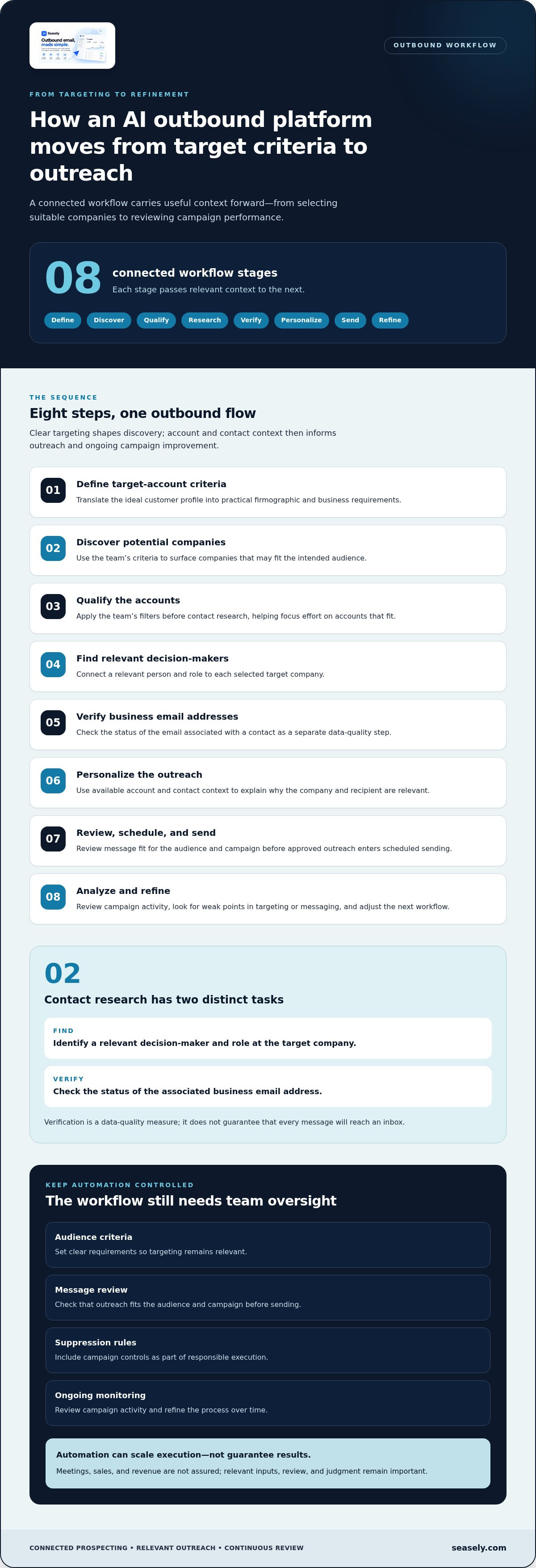
A connected outbound workflow carries useful context from one stage to the next. The team’s criteria shape account discovery; qualification narrows the account list; contact research identifies decision-makers; verification checks their business email addresses. Account and contact context can then inform personalized messages, which move into scheduled sending and campaign refinement.
In sequence: Define criteria, discover accounts, qualify companies, find decision-makers, verify email addresses, personalize outreach, schedule and send campaigns, then refine the workflow using campaign analysis.
This order matters. Broad or unclear targeting can surface poor-fit companies, while incomplete account context can weaken qualification and personalization. IBM’s overview of AI for sales describes how AI can support sales work. In outbound, its usefulness still depends on relevant inputs and appropriate review.
From ideal customer profile to verified decision-maker
Start by translating the ideal customer profile into practical firmographic and business criteria, such as the types of companies the team serves and the conditions that make an account relevant. Discovery uses those criteria to surface potential targets. Qualification then applies the team’s filters before contact research begins, helping focus effort on accounts that fit the intended audience.
Finding a decision-maker and verifying an email address are separate steps. The first connects a relevant person and role to a target company. The second checks the associated business email as a data-quality measure. Verification can help identify questionable contact data, but it doesn’t guarantee that every message will reach an inbox.
From personalized message to campaign refinement
Once the account and contact have been selected, their available context can guide a message draft. For example, the outreach can explain why the company fits the targeting criteria and why the recipient’s role is relevant. Reviewing the draft helps catch mismatches before it enters a scheduled campaign.
Scheduling and automated sending move approved outreach into execution. Automation should follow the team’s audience rules and campaign controls, not imply unlimited volume or risk-free delivery. After sending, campaign analysis can help teams review performance, spot weak points in targeting or messaging, and adjust the next workflow. Refinement is an ongoing process, not a promise of conversion gains.
Seasely connects company discovery and qualification with verified decision-maker contacts, personalized outreach, automated email sending, and ongoing optimization. Learn more about Seasely’s outbound workflow.
How to Compare AI Outbound Sales Platforms by Workflow Coverage
Compare platforms by tracing a real campaign through each stage, not by counting features. A capability may be built into the workflow, or it may rely on a separate tool and a manual handoff. That difference affects how targeting criteria, contact data, message drafts, and campaign status move through the process.
Which capabilities should the evaluation scorecard include?
Use the same scorecard for each platform. For every stage, note whether the capability is built in, connected through another tool, or handled manually. Then assess visibility, human review, and reporting alongside the capability itself. This makes it easier to distinguish a continuous workflow from a list of features that still requires staff to bridge the gaps.
| Stage | What to evaluate | Continuity and data visibility | Review and reporting |
|---|---|---|---|
| Discovery | Can target criteria guide company discovery? | Can the team see which criteria surfaced each account? | Can people review the target list before it advances? |
| Qualification | Can teams apply fit criteria before contact research? | Are qualification signals and decisions visible? | Can the team inspect why an account passed or failed? |
| Contact verification | Does the workflow identify decision-makers and verify their business email addresses as distinct steps? | Can users distinguish contact identity from email status? | Can questionable records be reviewed, and is verification status reportable? |
| Personalization | Can account and contact context inform outreach? | Is the source context available alongside the draft? | Can a person review and edit messages? |
| Sending | Does the workflow support campaign scheduling and sending? | Can users track campaign status without recreating records? | Are sending activity and campaign results visible? |
| Optimization | Can campaign analysis inform workflow changes? | Can teams connect results to audience and message choices? | Are reporting views useful for deciding what to refine? |
How should teams judge fit for their workflow?
Before evaluating an AI outbound sales platform, map your current process from target selection to campaign review. Note where staff copy data, switch tools, verify records, or wait for approval. Prioritize the stages that create the most manual work, then weigh them against your data needs and preferred level of human oversight.
Test the scorecard with a representative campaign, such as targeting a defined company type and preparing outreach for a relevant decision-maker. Follow a record from criteria to reporting. Look for repeated data entry, unclear status, or context that disappears between steps. A connected workflow should make handoffs easier to track, but the exact capabilities differ by platform. Evaluate what the process actually covers, including which steps depend on separate tools, rather than relying on feature labels alone.
Can AI Outbound Sales Automation Stay Relevant and Under Control?
Yes, but automation alone doesn’t make outreach relevant. It can scale repetitive execution, while message quality still depends on the targeting criteria, account information, and review process behind each campaign. An AI outbound sales platform should support clear controls so teams can manage who enters a campaign, what messages go out, and how results are monitored.
How can teams prevent generic or poorly targeted outreach?
Set qualification criteria before building an audience. Use relevant account context to shape message drafts, and check that details are accurate and meaningful to the intended recipient. A message that simply inserts a company name into generic copy isn’t useful personalization.
Before launch, review representative records and messages. Confirm that selected companies fit the audience, contact details are appropriate, and the message reflects the available context. Define a quality threshold in advance. If the data is unreliable or the drafts miss the mark, pause the campaign and correct the inputs before sending more.
What oversight supports responsible automated sending?
Assign an owner for each campaign and establish who can review, approve, pause, or change it. Set audience criteria and suppression rules before launch, including how the team will handle unsubscribe requests and contacts who should not receive further outreach. These controls make responsibilities clear when campaign conditions change.
Sending also needs ongoing attention. Monitor campaign activity, bounce indicators, replies, and suppression handling. Treat deliverability as an operational discipline: verified contact data can support better list quality, but it doesn’t guarantee inbox placement. If bounce patterns shift or responses indicate a mismatch, investigate and adjust the data, audience, or message before continuing.
Outreach and privacy requirements vary by jurisdiction and campaign context. Have the appropriate team review the requirements that apply to each market, and build those decisions into campaign setup and review. This keeps automation within the organization’s operating controls without treating software as a substitute for oversight.
Seasely connects company discovery and qualification, decision-maker email identification and verification, personalized outreach, automated sending, and ongoing optimization. Explore Seasely’s outbound workflow to see how connected execution can support a controlled process.
How Seasely Connects AI Prospecting and Outbound Execution
Seasely connects the work between defining a target market and refining outbound campaigns. Rather than treating prospect research and email execution as separate tasks, its AI outbound sales platform carries the process through linked stages, helping teams assess the workflow as a whole.
What the Seasely workflow covers
The process starts with company discovery and qualification against sales criteria. This helps teams focus prospecting on businesses that fit their intended audience before moving into contact research. Seasely then identifies and verifies decision-maker email addresses, addressing two distinct needs: finding relevant people and checking contact data.
With company and contact information in place, Seasely creates personalized outreach and automates scheduled email sending. Campaign activity can then inform ongoing workflow optimization. Each stage serves an operational purpose: criteria guide discovery, qualification narrows the account set, verified contacts support cleaner execution, and campaign observations help teams decide what to refine. Optimization supports learning and adjustment, not a guaranteed level of meetings, sales, or revenue.
What to assess before putting a platform into operation
Start with the operating rules. Define the target-company criteria and campaign goals, then assign ownership for setup, message review, and monitoring. Decide what needs human approval before outreach begins. These choices help the team use automation consistently while keeping appropriate oversight in place.
Set initial quality checks for account fit, decision-maker relevance, email verification status, and message accuracy. Review sample records and drafts before scheduled sending, and agree on what should trigger a pause or revision. As a campaign runs, use observations to adjust criteria, data checks, or messaging. Treat each change as a considered workflow decision, not an assumption that a particular outcome will follow.
For example, if a campaign surfaces companies that meet broad firmographic criteria but lack a clear fit with the team’s sales focus, revisit the qualification rules before expanding outreach. If the audience is sound but message drafts don’t reflect useful account context, improve the inputs or review process. The aim is to make each stage clearer and more consistent for the team.
Seasely brings discovery, qualification, contact identification and verification, personalized outreach, scheduled sending, and ongoing optimization into one outbound process. Explore Seasely’s AI outbound sales platform to see how it can fit your targeting criteria and oversight approach.
Build a More Connected Outbound Workflow
Evaluate an AI outbound sales platform by following the work from targeting through campaign refinement. The strongest fit is not simply the system with the most features. It’s the one that connects stages, makes data and handoffs visible, and supports the level of review your team needs.
Keep the fundamentals in view: clear criteria guide company discovery and qualification, verified decision-maker contacts support cleaner execution, and relevant messaging depends on useful context. Automated sending can reduce manual steps, while campaign monitoring and optimization help teams adjust the process over time. None of these capabilities guarantees meetings or revenue, but a connected workflow can make outbound work easier to manage.
Seasely brings company discovery and qualification, verified decision-maker email identification, personalized outreach, automated sending, and ongoing workflow optimization together. Explore Seasely’s AI outbound sales platform to see how its workflow can align with your targeting and oversight needs. Start with a clear process, then refine it as you learn.
Frequently Asked Questions
What is an AI outbound sales platform?
An AI outbound sales platform coordinates prospecting and outreach tasks for B2B teams. It can help discover and qualify target companies, identify and verify decision-maker email addresses, create personalized messages, schedule sending, and refine workflows. The defining feature is how these stages connect. A single-purpose email sender or contact database may support one task, but it doesn’t necessarily carry targeting context through the full outbound process.
How does an AI outbound sales platform find and qualify B2B leads?
An AI outbound sales platform uses team-defined sales criteria to discover potential target companies, then applies qualification rules to prioritize accounts before contact research. Criteria might include company types or business conditions that indicate a fit. Make those rules clear and review whether discovered accounts match them. Poor or overly broad criteria can lead to irrelevant prospects, even when later research and outreach steps are automated.
Can an AI outbound sales platform verify decision-maker email addresses?
Yes. Some platforms identify decision-makers and verify their associated business email addresses as separate steps. Identification connects a relevant person and role to a target company; verification checks the quality or status of the email data. That check can help teams spot questionable records before a campaign, but it isn’t a guarantee that every message will reach an inbox. Review contact data and monitor campaign signals after sending.
Can AI outbound sales software personalize emails automatically?
AI outbound sales software can use available company and contact context to draft personalized outreach. For example, a message might reflect why an account fits the team’s target criteria and why the recipient’s role is relevant. The result depends on the quality and relevance of the underlying information. Review drafts for accuracy, useful personalization, and audience fit before scheduling messages, rather than relying on name insertion alone.
How do AI outbound sales platforms differ from sales engagement platforms?
The categories can overlap. A sales engagement platform often focuses on executing and coordinating outreach activities, while an AI outbound sales platform may also connect company discovery, qualification, contact identification, and email verification with personalized sending and optimization. Product scope differs, so category labels alone don’t show where research happens or which steps rely on separate tools. Compare the actual workflow, handoffs, review controls, and reporting available to your team.
Is automated B2B email outreach safe for domain reputation?
No platform can guarantee that automated outreach will protect domain reputation. Teams can manage operational risk by targeting carefully, reviewing contact data and messages, following suppression preferences, and monitoring sending patterns, bounce indicators, and replies. Avoid treating verification as a guarantee of delivery. Outreach and privacy requirements vary by jurisdiction and campaign context, so have the appropriate team review the rules that apply to each market.
Does an AI outbound sales platform guarantee more meetings or sales?
No. Automation can reduce repetitive work and help teams run a connected prospecting and outreach process, but it can’t guarantee meetings, sales, or revenue. Outcomes depend on factors such as account fit, data quality, message relevance, timing, and the team’s follow-up. Use campaign observations to refine criteria and execution over time. Evaluate a platform by how well it supports that process, not by assuming a specific commercial result.