

Sales burnout builds when workload, quotas, and constant context switching outpace the support and recovery a team needs. Common sales team burnout causes include repetitive administrative work, frequent rejection, unclear expectations, and workplace conditions that make progress feel out of reach. The strain may show up as exhaustion, irritability, disengagement, or declining collaboration and deal quality.
Even strong sales teams can face these pressures, especially when performance is measured only by activity or closed revenue. This article explains how workload, fragmented attention, low-value tasks, and the work environment contribute to burnout, and how leaders can spot early warning signs. It also offers practical ways to reduce friction, set sustainable expectations, and support progress without treating exhaustion as a motivation problem.
Key Takeaways
- Identify repetitive admin and constant task-switching that crowd out focused selling, then simplify the workflow where possible.
- Look for changes in a rep’s usual activity, attitude, deal quality, or team participation as possible early warning signs.
- Review whether targets, role expectations, and workplace conditions make meaningful progress harder than it needs to be.
- Reduce avoidable friction, recognize useful effort, and build in clearer support and recovery before strain becomes a team-wide pattern.
1. Administrative workload and context-switching
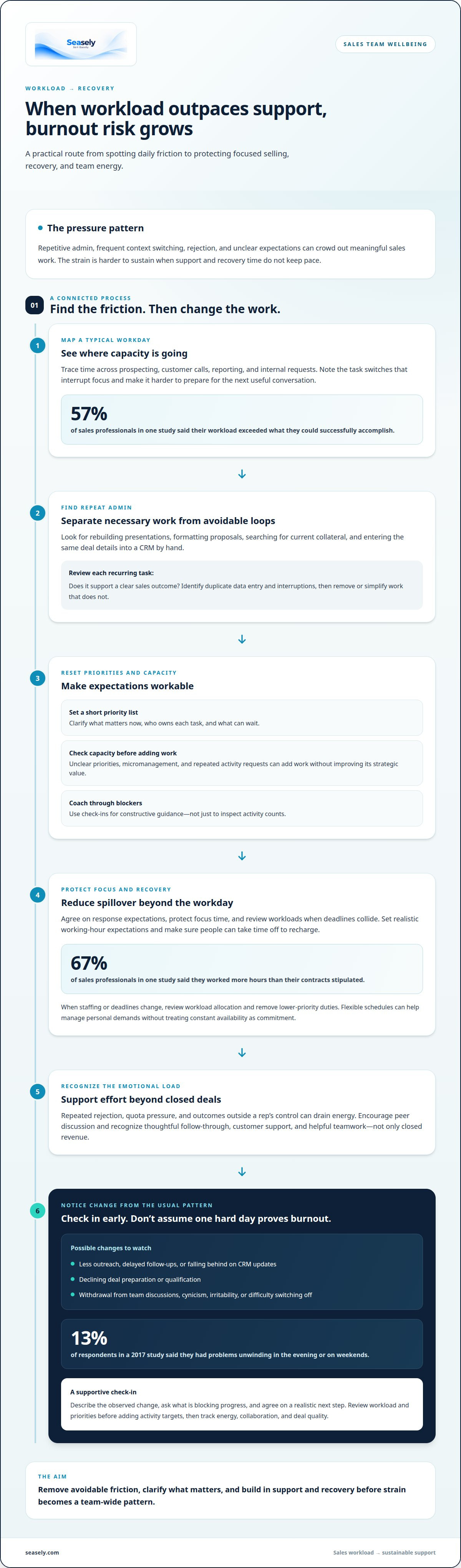
A workload becomes a burnout risk when its demands exceed the time and support available. In one study of sales professionals, 57% said their workload exceeded what they could successfully accomplish. That gap grows when representatives must switch between prospecting, customer calls, reporting, and internal requests. Each switch breaks focus and makes it harder to prepare for the next useful conversation.
Administrative work adds another layer. A representative might rebuild a presentation, format a proposal, search for current collateral, then enter the same deal details into a CRM by hand. These tasks matter, but repeated low-value work can crowd out planning and customer follow-up. Start by mapping a typical workday. Identify duplicate data entry and recurring interruptions, then remove or simplify tasks that do not support a clear sales outcome.
Management support shapes how workload feels. Unclear priorities, micromanagement, and repeated requests to increase activity can add tasks without improving their strategic value. Managers can set a short list of priorities, clarify task ownership, and review capacity before assigning more work. Check-ins should uncover blockers and provide constructive guidance, not just inspect activity counts.
Rejection, pressure, and emotional labor can turn a heavy workload into sustained strain. Salespeople handle repeated refusals while staying composed with prospects, then face recurring quota pressure and outcomes they cannot control. This emotional effort can drain energy and contribute to burnout, especially without recognition or support. Encourage peer discussion and recognize thoughtful follow-through, not just closed deals.
Personal pressures can make recovery harder. A representative with family responsibilities after work may have little time to reset if late reporting or messages extend the day. Agree on response expectations, protect focus time, and review workloads when deadlines collide. These steps cannot remove every pressure, but they can help teams identify what causes overload and address it before it becomes routine.
2. What are the warning signs of sales team burnout?
Burnout often shows up as a change from a representative’s usual pattern, not as one difficult day. A consistently productive rep may reduce outreach, delay follow-ups, or fall behind on CRM updates. Deal quality may also decline as preparation and qualification get less attention. Compare these changes with the person’s usual workload and results instead of treating one missed target as proof of burnout.
Cynicism and withdrawal can appear before performance falls. A rep who once shared deal insights may stop joining team discussions, show less interest in training, or sound unusually detached with prospects. Irritability, anxiety, and difficulty switching off after work can signal growing strain. In a 2017 study, 13% of respondents said they had problems unwinding in the evening or on weekends.
Risk tends to increase in roles that combine frequent rejection, demanding activity targets, and little control over outcomes. This may include outbound prospecting and other quota-driven sales work. The conditions create pressure, not the industry alone. Commission-based pay can intensify stress when income depends on deals that shift, stall, or fall through. Clear expectations and regular coaching help reps raise concerns before pressure erodes motivation.
These signs do not automatically mean someone lacks skills. Leaders can help prevent burnout with a private, specific conversation: describe the observed change, ask what is blocking progress, and agree on a realistic next step. If a rep’s follow-ups are slipping, for example, review workload and priorities before adding activity targets. Then track whether energy, collaboration, and deal quality improve.
Burnout can reduce productivity, increase absenteeism, and raise turnover, according to CDC OneLab. When experienced reps disengage or leave, teams may lose customer continuity and pipeline momentum, potentially weakening revenue performance. Responding early gives leaders more time to address workload and support before these patterns become entrenched.
3. Working on tasks that feel meaningless or in an unpleasant environment
Sales work feels less meaningful when time goes to tasks with no clear connection to customers or progress. For example, a representative may spend an afternoon correcting duplicate records while qualified prospects wait for follow-up. In a study of sales professionals, 67% said they worked more hours than their contracts stipulated. Repeated overtime can shrink recovery time and make routine tasks feel harder to sustain.
Understaffing can intensify the strain. When a teammate leaves, remaining reps may inherit accounts, reporting, and customer requests without having other work removed. Long hours and weekend work can then disrupt time away from the job. Poor work-life balance leaves less room to recover and can affect energy, focus, and mental health. When capacity changes, review workload allocation and remove lower-priority duties.
The workplace environment also shapes daily strain. Cramped, untidy, or dirty offices can make work more difficult, while unclear roles can fuel blame, resentment, and conflict. If two reps believe they own the same account, for example, unclear rules can turn coordination into competition. Define account ownership, responsibilities, and escalation steps, and invite staff to raise recurring sources of conflict.
Preventing burnout takes more than a wellness message. Set realistic expectations for working hours, watch for patterns of excessive time at the office, and make sure representatives take time off to recharge. Flexible schedules can help teams manage personal demands without treating constant availability as commitment. Recognition matters too: acknowledge work that supports customers and teammates, not just closed deals. Regularly review working conditions to see whether the culture enables meaningful work or rewards preventable strain.
4. Common causes of sales burnout
Common sales team burnout causes often combine pressure, limited control, and insufficient recovery. Unrealistic quotas can make each month feel like a fresh start, even after a strong quarter. Rejection brings repeated emotional strain, while public comparisons can make every setback feel visible. A quiet pipeline can deepen the pressure when representatives cannot tell whether their efforts are moving deals forward.
Burnout is not rare in sales. In a study of sales professionals, two-thirds strongly agreed they were close to experiencing burnout. The figure points to a broader issue than an individual’s motivation or skills: demanding systems can wear down even capable people. Sales professionals also have an annual turnover rate of 34.7%, making it important to examine workplace conditions alongside development and performance.
Poor communication can add to the strain. The Centers for Medicare & Medicaid Services identifies weak communication among staff as a potential contributor to higher stress and burnout. A rep might receive conflicting priorities from a manager and a sales operations lead, then be judged against goals that reflect neither set of instructions. Clarify ownership, explain changes in priorities, and give constructive feedback before confusion builds.
Look for patterns rather than blaming a single team member. Review whether quotas reflect market conditions, whether reps can see deal progress, and whether recognition includes useful controllable work. A representative who consistently supports colleagues or improves pipeline quality contributes to team success, even before a deal closes. Managers can also discuss career development and role satisfaction, then use those conversations to address concerns early. To reduce avoidable friction in prospecting workflows, review outbound sales operations as part of the wider system.
Seasely: Seasely AI outbound sales platform
Seasely provides an AI outbound sales platform for B2B teams that need a more structured prospecting workflow. It discovers and qualifies target companies, delivers verified decision-maker email addresses, and supports personalized outreach with automatic email sending.
For teams where repetitive lead generation and outreach administration add strain, this can help organize those parts of the process. Leaders can then focus on workload balance, coaching, realistic expectations, and the workplace conditions that contribute to burnout. Automation supports sales operations; it doesn’t replace the management support and recovery a team needs.
Contact Seasely to discuss how its platform could fit your team’s outbound workflow.
Build a more sustainable sales operation
Treat burnout as an operational signal, not a personal failing. The causes of sales team burnout can reveal where expectations, processes, or support no longer match the work. Make the next step specific: choose one point of friction, assign an owner, and set a date to review whether the change helped.
Include the people closest to the work in that review. Ask what interrupts focused selling, which tasks add little value, and where progress feels unclear. Then adjust one process at a time and watch for changes in energy, collaboration, and follow-through. A regular feedback loop helps leaders respond before strain becomes the team’s normal operating condition.
If outbound work is one source of avoidable friction, Seasely can help organize that workflow. Talk with Seasely about reducing outbound strain and consider where structured sales operations fit your team’s approach. Small, deliberate improvements can create a more sustainable way to work and give the team room to build momentum.
Frequently Asked Questions
How can sales leaders prevent burnout long term?
Prevent burnout by treating team capacity as an ongoing management responsibility. Review workload during regular one-to-ones, then adjust priorities when urgent requests displace planned work. Set realistic targets, recognize constructive effort, and make recovery time part of normal team planning. For example, after a demanding launch, managers can review what caused the extra hours and change the next cycle’s workload before the same pattern repeats.
What are the warning signs of sales team burnout?
Warning signs include difficulty switching off, declining sleep or exercise routines, and less interest in development or team activities. A rep may also sound unusually robotic in customer conversations or take more sick days. Look for changes that persist across work and daily routines. A private check-in can help clarify whether expectations, resources, or personal pressures need attention.
What causes burnout in sales teams?
Burnout can develop when sustained pressure combines with too little control, support, or recovery. A representative might face repeated rejection, unpredictable deal outcomes, and a competitive culture that rewards only individual wins. Unclear role boundaries can add friction, particularly when account ownership overlaps. Consider how these conditions interact across the team instead of treating each person’s fatigue as an isolated motivation issue.
What is burnout?
Burnout is a response to chronic stress that can leave someone physically, mentally, and emotionally exhausted. It may also involve detachment from work and a reduced sense that effort matters. It is not simply a difficult day or a temporary dip in enthusiasm. In sales, sustained pressure without enough support or recovery can make it harder to stay engaged with customers and colleagues.
How do unrealistic sales quotas and targets contribute to burnout?
Unrealistic quotas create pressure when the required outcome exceeds what market conditions, pipeline quality, or available selling time can support. Reps may respond by extending their hours or chasing low-fit opportunities, yet remain unable to control whether prospects buy. Managers can review targets against territory conditions and pipeline stages, then break larger goals into shorter milestones that make progress visible.
How do CRM tools, administrative work, and constant performance tracking contribute to burnout?
CRM work becomes draining when representatives repeatedly enter the same information or update fields that do not guide a decision. Constant tracking can add strain when managers rely on activity counts without discussing deal context. A high call total, for example, may hide poor account fit or blocked follow-ups. Keep required records focused on useful decisions, and discuss pipeline quality and obstacles during performance reviews.


