

The average cold email response rate is 1-5%, which gives you a baseline, not a guarantee of performance. To improve outbound email response rates, make each message relevant to the recipient’s role, company priorities, and current context. A message that could go to anyone gives the reader little reason to reply.
It’s reasonable to expect a useful benchmark and practical guidance, not a formula that treats every buyer alike. Response rates depend on audience fit and message quality, so compare similar campaigns and look for patterns in who responds. Use benchmarks as a starting point, then refine your targeting and messaging based on what prospects are actually dealing with.
This article explains how to interpret cold email benchmarks and use company context to improve outbound email response rates. You’ll learn which details make personalization useful, how to connect a business priority to a concise message, and how to assess replies without relying on one number. The goal is a deliberate process for deciding whom to contact and what to say.
Key Takeaways
- Anchor each opening in a buyer’s role, problem, or timely trigger so the message feels specific rather than interchangeable.
- Use response-rate benchmarks as a baseline, then assess how audience fit and message relevance shape your own results.
- Connect executive outreach to a concrete company priority, not just the recipient’s title or general industry.
- Build a measured follow-up cadence that adds value with each touch instead of repeating the same request.
1. Personalization relevance and buyer challenges
Relevance starts with the right audience, not a clever greeting. 87% of buyers say sales emails they receive miss a relevant challenge facing their organization. To improve outbound email response rates, target people whose responsibilities connect directly to the problem your message addresses. A broad list can fill a campaign with contacts who have no reason to engage.
The U.S. Environmental Protection Agency recommends defining audiences narrowly by attitudes, demographics, geography, or behavior. In B2B outreach, combine practical signals such as role, industry, company activity, and a recent business change. For example, an operations leader at a company expanding into a new region may care about a different issue than a finance executive at the same firm. Use the detail to shape the value proposition, not merely to insert a company name.
Buyers may also have preferred channels. Use a channel they have actively used or said they prefer, and keep your message consistent across touchpoints. If a prospect engages with your team on LinkedIn, an email that refers to that exchange has more context than an unrelated template. Don’t assume every buyer wants the same sequence or frequency of contact.
Respond to intent while it is useful. The available market finding says responding to leads after 30 minutes is 21 times less effective. When a prospect requests information or signals interest, route the activity promptly and make the reply address that specific action.
Targeting and contact quality influence replies because accurate contact details put relevant messages in front of suitable buyers. Sender reputation and deliverability also affect whether messages reach an inbox; spam filters may divert them before a prospect sees them. Verify addresses, remove bounced contacts, and avoid repetitive bulk copy. No sending platform can guarantee inbox placement.
Common mistakes include generic openings, personalization based only on a job title, and an unclear request. Replace filler with a role-specific problem or timely trigger, then make one relevant next step easy to understand.
2. Cold email response-rate benchmarks
Cold email response rates provide a reference point, not a universal target. The average cold email response rate is 1-5%. Common Room’s 2026 customer conversations put reported email replies around 1%. Austin Belcak advises new cold emailers to expect 5%, while experienced senders may reach around 20% or more. These figures describe different contexts, so compare like with like.
Check what each benchmark counts. One campaign reports an overall reply rate of 1-2%, including negative and out-of-office responses. Its positive reply rate is approximately 0.3-0.5%. That distinction matters: a campaign can generate replies without creating useful sales conversations. Track positive replies separately, and use the same definition across campaigns.
Make your call to action easy to answer. Ask one direct, low-pressure question tied to the email’s value, such as whether a specific challenge is a current priority. Offering two relevant options can also make replying easier. Don’t combine requests for a meeting, a referral, and product feedback in one message.
For U.S. commercial email, account for CAN-SPAM when building campaign workflows. Keep sender information and subject lines accurate, provide an opt-out method, and handle opt-out requests as part of campaign operations. Treat these as compliance checks, not optional copy improvements.
A/B testing can reveal which message elements affect replies. Test one variable at a time, such as the opening, call to action, or subject line. Send each version to comparable audience segments, then compare positive reply rates over the same measurement period. Changing several elements at once makes it difficult to tell which change mattered.
Use the benchmark to set a baseline, then refine the message against actual responses. Teams organizing this workflow can explore outbound email optimization as part of a systematic testing process.
3. Company-based personalization for executives
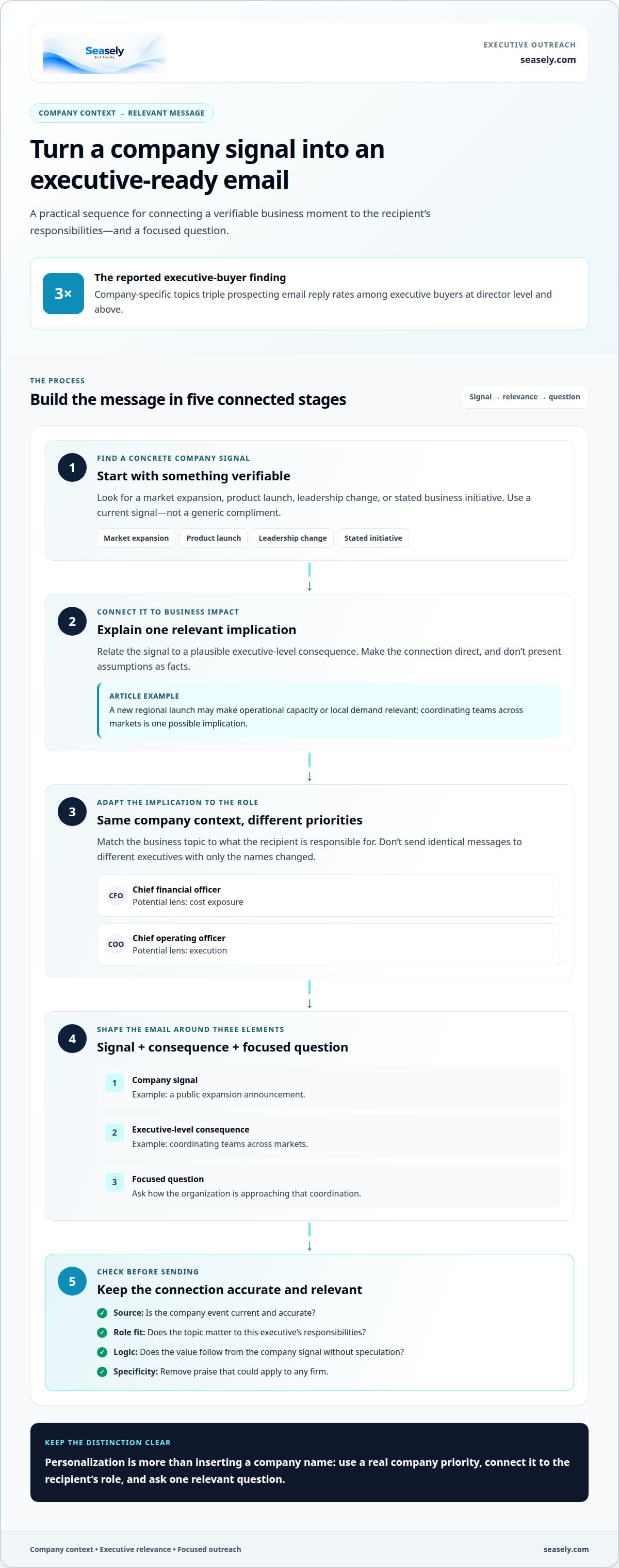
Company-specific topics triple prospecting email reply rates among executive buyers at director level and above. That finding makes account context more useful than a generic compliment. Executives assess strategic fit, business impact, and timing. Start with a verifiable company priority, then connect it to one relevant implication.
Look for concrete signals, such as a market expansion, product launch, leadership change, or stated business initiative. For example, an executive overseeing a new regional launch may be weighing operational capacity and local demand. Refer to the launch accurately, then explain why your message relates to that business moment. Don’t present assumptions as facts.
Build the email around three elements: a company signal, an executive-level consequence, and a focused question. A signal might be a public expansion announcement. The consequence could be a need to coordinate teams across markets. A useful question could ask how the organization is approaching that coordination. Keep the connection direct, not speculative.
Match the company topic to the recipient’s responsibilities. A chief financial officer may prioritize cost exposure, while a chief operating officer may focus on execution. If both executives work at the same company, don’t send identical messages with only the names changed. Keep the shared company context, but adapt the implication and question to each role.
Before sending, check the source, relevance, and wording. Confirm that the company event is current, that it matters to the executive’s responsibilities, and that your proposed value follows logically. Remove praise that could apply to any firm. A concise reference to a specific initiative gives the recipient a clear reason to consider and respond to your message.
4. How many follow-ups should an outbound email sequence include, and how far apart?
A practical starting point is four follow-ups, one every five business days. This spacing gives a prospect time to respond while keeping the conversation active. Treat it as a baseline, then adjust the message when a reply, new signal, or change in relevance calls for a different next step.
Persistence matters, but each follow-up should give the prospect a reason to engage. One message can clarify the business problem. Another can offer a useful example or explain a relevant outcome. A later note can close the loop politely. Repeating the original pitch across four messages adds volume without giving the buyer new context.
Many senders stop too early: 44% of cold emailers give up after the first attempt. Meanwhile, 60% of prospects say no four times before saying yes. These findings support a measured sequence, not endless chasing. Continue only while the contact remains appropriate and each message can provide a distinct, relevant reason to reply.
A five-step cadence can combine concise value with a low-pressure call to action. For example, the opening email introduces the problem and asks a focused question. The next touch adds context, while another shares a useful observation. Later follow-ups can address a likely concern and end the sequence with a courteous close. Keep each email focused on one point.
Review replies as well as sends when assessing your cadence. If prospects mention timing, record it and pause or adjust the next touch. If they decline, stop the sequence. If messages receive no response, review the audience, timing, and value proposition before extending the cadence.
Use a structured outbound email sequence to organize follow-up timing and keep each touch purposeful.
Seasely: Seasely AI outbound sales platform
Seasely brings lead generation, automatic email sending, and outbound optimization into one platform for B2B teams. It can help when your team needs a more organized way to identify target companies, reach decision-makers, and execute relevant outreach. Use the approach from this guide to define the audience and message, then refine campaigns based on response patterns.
The platform supports outbound operations from discovering and qualifying target companies to sending personalized outreach. This can reduce manual coordination across prospecting and email execution, while keeping relevance and performance in view. It doesn’t replace sound targeting or thoughtful messaging; those decisions still shape the quality of each campaign.
If you’re evaluating a more systematic outbound workflow, visit Seasely to learn more.
Build a more useful learning loop
Treat your next campaign as a learning cycle, not a one-time send. Record which audience, message, and timing led to meaningful conversations. Review those patterns before changing the next campaign, so you can distinguish a weak message from a poorly matched audience. This makes each outreach effort a clearer basis for your next decision.
A disciplined process to improve outbound email response rates depends on steady refinement. Keep what earns relevant replies, revise what creates confusion, and remove steps that add no value for the buyer. Small, deliberate adjustments help you see what’s working and where to focus next.
When you’re ready to put that process into operation, contact Seasely to discuss your outreach. A more focused campaign starts with a clear audience, a useful message, and the willingness to learn from each response. You can build that rhythm one thoughtful improvement at a time.
Frequently Asked Questions
Before you hit send, ask yourself: Is this relevant?
Yes. Check whether the recipient’s role, company situation, and likely priorities connect to your email’s point. Then ask whether the message makes that connection clear without requiring the reader to guess. For example, if you refer to a company initiative, explain why it matters to the recipient’s work. If you can’t make that link, refine the audience or message first.
What is a good outbound email response rate by industry and campaign type?
There isn’t one useful target for every industry and campaign type. A cold introduction to senior leaders differs from a follow-up to someone who showed interest, so compare campaigns with similar audiences and goals. Track positive replies separately from all replies, and record the segment, offer, and campaign type. This gives your team an internal benchmark without treating unlike campaigns as equivalent.
Which subject lines and opening lines improve cold email reply rates?
Use a short subject line that signals the email’s topic without exaggeration. Austin Belcak identifies two-to-four-word subject lines as having the highest response rates in the cited data. For openings, Austin Hughes reports that signal-driven openers received twice the reply rate of other styles in his dataset. Refer to a concrete company event or business issue, then connect it to your email’s purpose.
How should outbound emails be personalized without sacrificing scale?
Use a repeatable structure, but fill it with accurate recipient and company context. A useful workflow can draw on the prospect’s role, organization, and relevant business activity, then check that the message makes a sensible connection. Don’t include details simply because they’re available. For example, mention a product launch only if it relates to the challenge you address.
What is the ideal length and structure for a cold outreach email?
Keep the email focused enough to understand quickly. Start with a specific reason for writing, state the relevant problem or value, and close with one clear question or next step. Remove background that doesn’t help the recipient judge relevance. Instead of listing several features, explain one way your offer relates to the prospect’s stated priority and ask whether it’s worth discussing.
Which outbound email tools and plans offer useful personalization and testing features, and what do they cost?
Compare tools by how they support lead discovery, tailored messaging, sending, and campaign refinement. Seasely combines lead generation, personalized outreach, automatic email sending, and campaign optimization for B2B teams. Its plans differ by monthly lead allowance, so match the plan to your prospecting needs and review its current pricing when selecting an option. No tool can guarantee replies; monitor campaign results and adjust your approach.


