

More personalization doesn’t automatically make a cold email more relevant. Learning how to personalize cold emails starts with choosing one or two details that connect directly to your offer, then explaining why they matter to that prospect. A recent vacation or repeated mentions of the company name can feel intrusive or forced, so relevance matters more than volume.
Personalization can seem like a research task that takes too long to scale. A practical approach is to automate repeatable work while using human judgment to assess the details and message. This guide explains what useful personalization looks like, how to balance automation with review, and how to build a first line around a relevant signal. It also includes adaptable sales email templates and guidance on choosing details that fit your audience and offer instead of relying on generic merge fields.
Key Takeaways
- Choose prospect details that connect directly to your offer, and leave out personal information that could feel intrusive.
- Automate research and repetitive tasks, then review each message to make sure its details and relevance hold up.
- Build first lines around useful signals, such as a business need or a relevant professional update.
- Adapt email templates to the audience and offer so each message feels specific rather than filled with generic tokens.
1. What does “personalized” mean in the context of cold emails?
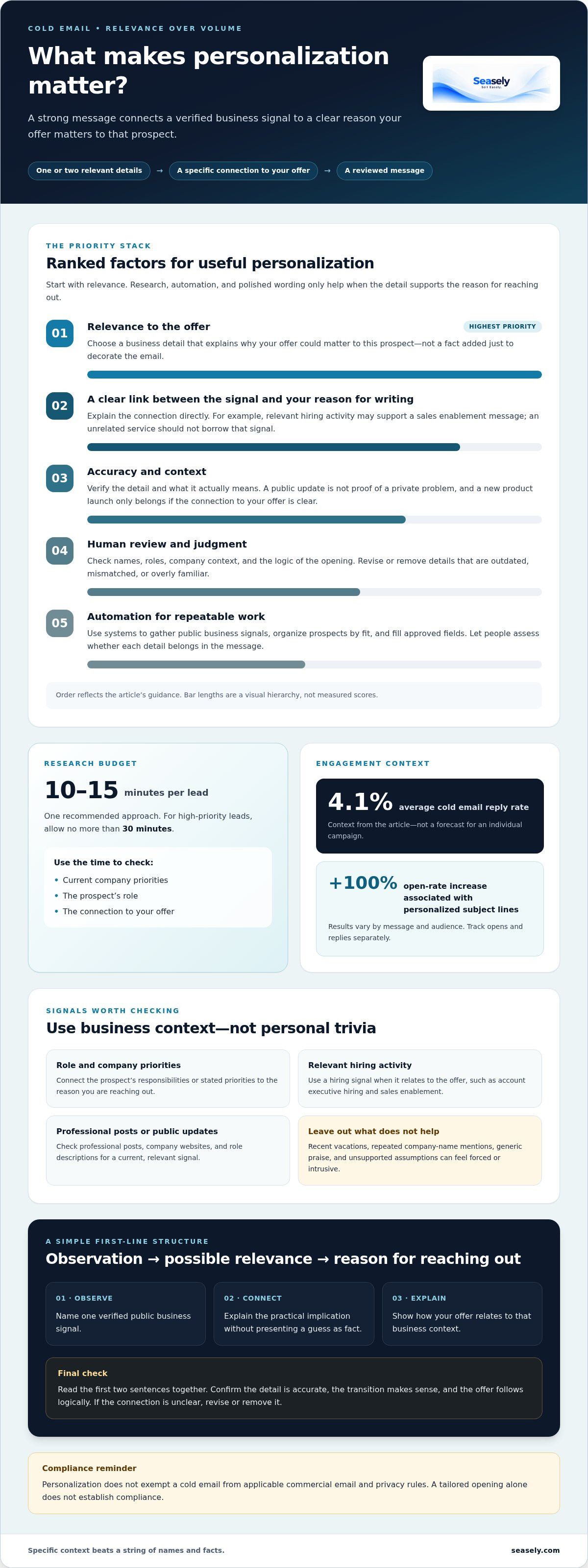
Personalization connects a prospect’s relevant business context to the reason you’re writing. Use one or two details and explain how they relate to your offer. For example, if a company is hiring account executives, a sales enablement message could refer to that hiring signal and explain its relevance. The detail should support your message, not just decorate it.
More research doesn’t always produce a stronger first line. Avoid personal details such as a prospect’s recent vacation, which can feel intrusive and unrelated to a business need. Repeating the company name or piling on facts can also make an email feel forced. Ask yourself: could this detail explain why the offer matters to this prospect? If not, leave it out.
In the US, personalization doesn’t exempt a cold email from applicable commercial email and privacy rules. Assess the message and its recipient against the rules that apply. A tailored opening alone doesn’t establish compliance.
Start your research with the company’s public business information, then look for a current signal related to your offer. Review its website, role descriptions, or professional posts on LinkedIn. Choose one useful fact, verify its context, and write a first line connecting it to your reason for reaching out. Skip personal details unrelated to work.
Personalize business details such as a prospect’s role, company priorities, relevant hiring activity, or a professional post that reveals a problem your offer addresses. Focus the first line on one signal. Avoid generic praise, unsupported assumptions, and claims about results you can’t substantiate. A specific connection is more useful than a string of names and facts.
Personalization can affect engagement, but results vary by message and audience. Cold emails have an average reply rate of 4.1%, and personalized subject lines have been associated with a 100% increase in open rates. Treat those figures as context, not a forecast for an individual campaign. Track opens and replies separately to see which details work for your audience.
2. Balancing automation with human judgment
At enterprise scale, automation should handle repeatable tasks, while people assess relevance and exceptions. Use systems to gather company signals, organize prospects by fit, and fill approved fields. Then have a reviewer assess whether each signal supports the email’s purpose. A hiring announcement may fit a recruiting offer, for example, but not an unrelated finance service.
Set a research budget before drafting. One recommended approach allows 10-15 minutes to research each lead, with no more than 30 minutes for high-priority leads. Use that time to inspect the company’s current priorities, the prospect’s role, and the connection to your offer. If those checks reveal no relevant link, don’t manufacture one.
Keep data collection separate from message approval. Automation can gather public business details and add them to a draft. A human reviewer can check names, roles, company context, and the logic behind the opening line. For example, a draft mentioning a new product launch should explain why that launch makes the offer relevant. If the connection is unclear, revise the line or remove it.
At scale, standardize the review process, not the wording of every email. Set clear rules for which fields may be used, how details are verified, and which claims need evidence. Reviewers can flag outdated job titles, mismatched company facts, or personalization that feels overly familiar. These checks protect message quality while allowing account-specific context.
Use campaign feedback to refine the workflow. Compare replies and engagement across meaningful audience segments, then identify which signals lead to relevant conversations. Avoid treating a single response as proof that a personalization approach works. Teams building a repeatable sending process can explore automated email workflows as part of that operation.
3. First-line frameworks and examples
A strong first line links a business signal to a practical implication. Follow this sequence: observation, possible relevance, reason for reaching out. To learn how to personalize cold emails, try drafting each part separately. For example, a software company announcing a new integration may need to coordinate data across systems. Refer to the announcement only if your offer addresses that work.
Base the opening on what the prospect has actually shared. If a professional association publishes a case study about lengthy approval workflows, a relevant message might say: “Your case study describes delays in approval workflows. We help teams organize that process.” Don’t treat a public observation as proof of a private problem. Explain the connection carefully.
If you’re deciding how to personalize cold emails across account segments, use a framework that leaves room for meaningful variation. A healthcare technology prospect may care about implementation workflows, while a manufacturer may focus on production planning. The first line should identify relevant context, and the next sentence should explain how your offer connects. Don’t force one industry’s language into another’s message.
Use a reusable structure, then replace its fields with verified, account-specific details:
- Published initiative: “Your update about [initiative] caught my attention. It relates to [business task] that we support.”
- Operational signal: “I saw [publicly stated change]. Our work may be relevant to [related process].”
- Industry context: “Teams in [industry] often manage [specific workflow]. We help with [related task].”
Before sending, read the first two sentences together. Make sure the detail is accurate, the transition makes sense, and the offer follows logically. If the line relies on guesswork, remove the assumption and use a broader, factual opening.
4. Personalized sales email templates
A useful template standardizes the structure, not the reason a prospect is receiving the message. Choose personalization fields based on your offer, target audience, buyer persona, and industry. For example, a message to a sales operations leader should use a different business signal from one written to a finance executive. Limit placeholders to details that change the message’s relevance.
Use this structure to build a first-touch email:
- Subject: [Relevant company priority]
- Opening: “I noticed [verified business signal] at [company].”
- Connection: “That can make [specific task] harder for [role or team].”
- Value: “We help [audience] address [related challenge] through [offer].”
- Close: “Would a short conversation about [specific topic] be useful?”
For example, a message to a company expanding its sales team might say: “I noticed your team is hiring account executives. Coordinating consistent onboarding can become harder as teams grow. We help sales leaders organize outbound workflows. Would discussing your process be useful?” Each sentence has a purpose. Remove any that doesn’t connect the hiring signal, business challenge, or offer.
A follow-up template should add context rather than repeat the opening. Try: “I’m following up because [specific priority] may affect [relevant process]. If [offer-related outcome] is on your roadmap, I can share how teams approach it.” Use this only when the priority and outcome genuinely fit the prospect. Don’t add a personal detail just to make the second message look different.
Before using a template across an enterprise campaign, test its fields with different roles and industries. Replace each placeholder with real prospect data, then read the message without the template markers. If the email still sounds interchangeable across unrelated accounts, refine the relevance fields and value statement. Build personalized outbound email workflows to connect structured templates with scalable sending.
Seasely: Seasely AI outbound sales platform
Seasely brings lead generation and personalized outreach into a single AI-powered outbound sales platform for B2B teams. It discovers and qualifies target companies, delivers verified decision-maker email addresses, and supports automatic email sending. Turn to it when your team needs to coordinate prospect discovery and outreach without building each step separately.
For enterprise teams, the practical value lies in connecting relevant prospect information to message execution. Seasely creates personalized outreach messages and helps optimize outbound operations over time. Your team can use this workflow to scale activity while keeping its audience, offer, and message aligned.
Personalization still depends on choosing details that matter to each prospect. Use a clear review process to keep outreach relevant as you scale. Explore how Seasely fits your outbound workflow at seasely.com.
Make relevance part of your sending process
Make your approach to how to personalize cold emails a repeatable practice. Set clear standards for which prospect signals qualify, how each detail connects to your offer, and when a draft needs human review. This gives your team a shared quality bar without forcing every message into identical wording.
Then refine your standards based on campaign responses. Look for patterns in the conversations prospects choose to start, not just whether they opened a message. If a particular signal consistently leads to relevant replies, document why it fits and apply that learning to similar accounts. If the connection feels weak, revise the message before using it more widely.
When you’re ready to discuss how a structured outbound workflow could support your team, contact Seasely to discuss your outreach. Keep the process focused on useful details, clear judgment, and steady refinement. Each improvement gives your next message a stronger reason to reach the right person.
Frequently Asked Questions
What does “personalized” mean in the context of cold emails?
Personalization means giving a recipient a specific reason to find your offer relevant, not simply inserting their name. Ask whether the opening would still make sense if you sent it to someone else at another company. If so, add account context or clarify the connection. The goal is recognition, not proof that you researched someone’s private life.
How Long Should it Take to Write a Custom First Line?
There’s no fixed amount of time needed to write a custom first line. It depends on the quality of the available information and how directly it relates to your offer. A company with a clear public initiative may need little review, while an unclear signal takes longer to interpret. Set a stopping point: if your research doesn’t reveal a credible business connection, use a broader, relevant opening instead.
What makes a cold email feel genuinely personalized?
A genuinely personalized email connects an accurate observation to a sensible implication and a relevant next step. For example, a logistics company announcing a warehouse expansion might need to coordinate new operations. A message about related planning support could make sense if that’s what you offer. Don’t claim the expansion creates a specific problem unless the company has indicated one.
How do you personalize cold email subject lines and opening lines?
Make the subject line signal the email’s business topic, then use the opening to show why it matters to the recipient. For a finance leader, “Quarterly reporting workflow” may be more useful than a vague greeting. The first line can refer to a relevant public initiative. Keep the two elements consistent so the subject doesn’t promise a different conversation.
How can you personalize cold emails at scale with automation or AI?
Use automation to organize verified account fields and draft messages from approved patterns. Set rules for missing, outdated, or conflicting information so those records pause for review instead of generating guessed details. AI can adapt wording to a role or account segment, while human reviewers check factual accuracy and fit. Track outcomes by segment to refine your rules.
What are examples of personalized cold emails for different industries?
For a SaaS company, connect a public integration launch to a relevant workflow challenge. For a professional services firm, refer to a published practice-area update and relate it to your offer. For a manufacturer, cite a product-line announcement only when your solution supports that work. In every case, keep the observation factual, explain the business connection, and avoid assuming an unstated problem.


