

A content download is a signal, not proof that a prospect is ready for sales outreach. Knowing how to qualify B2B leads starts with assessing whether the company fits your ideal customer profile, whether the contact’s role and needs align with your offer, and whether engagement suggests buying intent. This helps distinguish promising prospects from contacts who need more information or aren’t a fit.
It’s easy to focus on activity alone: a click, a visit, or a form fill. These actions become more useful when considered alongside company details, the buyer’s role, and their decision stage. That context helps sales decide whom to approach and what to say.
This guide shows how to qualify B2B leads by defining fit, distinguishing lead types, researching target companies, and reading content engagement before outreach. You’ll learn how to combine those signals into a practical qualification process and where automated lead generation and outbound workflows can support it.
Key Takeaways
- Set clear company-fit and role criteria before reviewing individual contacts, so qualification stays consistent.
- Use lead type to distinguish early interest from stronger purchase intent and choose an appropriate follow-up.
- Research company information and professional profiles to validate relevance, responsibilities, and potential needs.
- Read content engagement in context: repeated interest in decision-stage resources can signal stronger intent than a single interaction.
- Combine fit, research, and engagement signals into a practical process that helps sales prioritize relevant outreach.
1. Meaning and benefits of B2B lead qualification
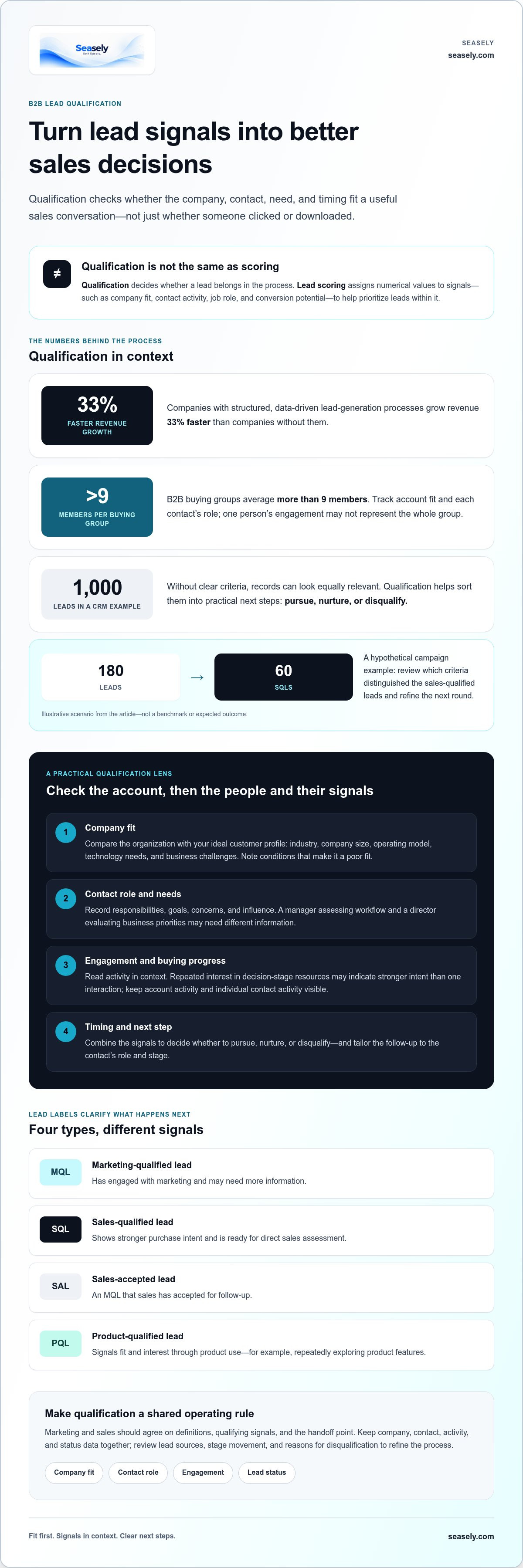
B2B lead qualification checks whether a contact and their company match the conditions for a useful sales conversation. It separates a qualified lead from a contact who lacks the right fit, need, role, or timing. Lead scoring supports that decision by assigning numerical values to signals such as company fit, contact activity, job role, and conversion potential. Qualification judges whether the lead belongs in the process; scoring helps teams prioritize leads within it.
Consider a CRM with 1,000 leads. Without defined criteria, sales may treat every record as equally relevant, even when company size, role, and engagement differ. A qualification process sorts records into practical actions: pursue, nurture, or disqualify. This improves generation efficiency by directing attention toward stronger matches and showing marketing which sources produce useful conversations. Companies with structured, data-driven lead-generation processes grow revenue 33% faster than companies without them, according to the market fact supplied for this article.
Qualification also needs to account for buyer-group intent. B2B buying groups average more than 9 members, and managers and associates can influence the journey early. A single engaged contact may be researching, while another person in the same account controls budget or evaluates implementation. Record the account’s fit and each contact’s role, then look for related activity across the group. That gives sales a wider view than treating one download as a buying decision.
Lead labels clarify the next step. A marketing-qualified lead (MQL) has engaged with marketing and may need more information. A sales-qualified lead (SQL) shows stronger purchase intent and is ready for direct sales assessment. A sales-accepted lead (SAL) is an MQL that sales has accepted for follow-up. A product-qualified lead (PQL) signals fit and interest through product use. For example, a prospect who repeatedly explores product features may need a different response from someone who has only read an introductory guide.
Marketing and sales should agree on these definitions, the qualifying signals, and the handoff point. Marketing can report which campaigns attract fitting accounts; sales can return feedback on conversations and disqualified leads. A CRM makes this loop usable by keeping company, contact, activity, and status data together. Track movement between stages, lead sources, and reasons for disqualification, then review the patterns together. If 180 leads produce 60 SQLs in a hypothetical campaign, teams can examine which criteria separated those 60 and refine the next round of outreach. This turns qualification into shared operating rules, not an individual judgment made at the last moment.
2. Defining an ideal customer profile and buyer personas
An ideal customer profile (ICP) describes the organizations most likely to benefit from your solution. Define it with observable attributes: industry, company size, operating model, technology needs, and business challenges. For example, enterprise software targeting companies with 500 or more employees needs a clear size threshold. Add the conditions that make an account a poor fit, such as incompatible systems or needs outside your offer. These boundaries make targeting and lead qualification consistent across campaigns.
Buyer personas describe the people involved inside those accounts. Separate their responsibilities, goals, concerns, and influence rather than treating every contact as the same buyer. Directors and managers make up the majority of participants in the average B2B buying group, while managers and associates increasingly influence the journey early. B2B buying groups average more than 9 members. A useful persona map might distinguish an operations manager assessing workflow from a director evaluating business priorities.
How can you qualify leads with long sales cycles or multiple decision-makers? Score the account against your ICP, then track each contact’s role, needs, and engagement over time. Keep the account active as new stakeholders enter the process, and advance it when combined signals indicate fit and buying progress.
Map the buyer journey at both the account and persona levels. For each stage, note the question a stakeholder needs answered and the evidence that signals progress. An analyst may first compare approaches, while an operations lead examines implementation requirements. A director may later evaluate strategic value. This map helps teams interpret interest in context instead of mistaking one person’s research for an account-wide decision.
Match buyer-enablement content to those questions. A practical guide can support early discovery; a case study or implementation overview can help stakeholders assess options. Personalize messages by role and channel, while keeping the core claim consistent across email, webinars, and sales conversations. A campaign for technical evaluators should emphasize compatibility and workflow, while a director-focused message can address business priorities. Track which content prompts meaningful follow-up from each persona.
Turn the ICP and persona map into usable CRM fields. Record account fit, persona, journey stage, known need, and the next useful action. Review disqualified accounts and stalled opportunities with marketing and sales, then refine targeting criteria based on patterns. If the team targets several industries, compare each campaign’s qualified conversations rather than raw response counts. For teams ready to apply these rules to outbound workflows, automated B2B sales outreach can connect account targeting with prospect engagement.
3. Marketing-qualified, sales-qualified, product-qualified, and service-qualified leads
A marketing-qualified lead (MQL) has shown interest through marketing activity, such as reading a guide or attending a webinar. That engagement suggests relevance, but doesn’t establish purchase intent on its own. A sales-qualified lead (SQL) has shown stronger intent and meets the criteria for a direct sales conversation. The distinction helps teams decide which prospects need useful follow-up and which are ready for sales assessment.
Product-qualified leads (PQLs) show interest through meaningful product use, such as exploring a feature during a trial. Service-qualified leads show a relevant need through an existing service interaction, such as asking about a capability or support option. These labels depend on the business model. A company with a self-serve product may use PQL signals, while a service-led firm may rely more on service conversations.
How do marketing and sales teams agree on MQL and SQL qualification criteria? Define the signals together, including account fit, relevant role, engagement, and evidence of need. Regularly review accepted and rejected handoffs, then adjust the criteria based on sales feedback and funnel outcomes.
Keep lead type separate from lead quality. An MQL can match the target profile but still be early in its journey; an SQL should meet the agreed threshold for sales follow-up. A score or label should reflect evidence, not a single isolated click. For example, a relevant job role combined with repeated visits to a product comparison page may warrant review, while one introductory download may call for more education.
To avoid contacting prospects before they’re ready, set a clear handoff rule. Marketing can nurture contacts who show early interest, then alert sales when stronger buying signals appear. Sales teams can accept, reject, or return a lead with a reason, such as poor fit, missing need, or early timing. This feedback helps marketing refine its approach and prevents funnel stages from becoming labels without operational meaning.
A practical sales qualification process can use BANT: budget, authority, need, and timeline. Treat it as a conversation framework, not a rigid checklist. A sales representative can first confirm the business problem, then identify who evaluates options, how the organization approaches budget, and what timing matters. Record the answers in the CRM so the next action reflects the prospect’s actual context.
Use CRM reporting to compare lead types by source, handoff status, and eventual sales progression. If webinar MQLs often need more product detail, update the nurture sequence before routing them. If product engagement consistently prompts useful sales conversations, define that behavior as a PQL signal. This keeps qualification criteria testable and aligns each funnel action with supporting evidence.
4. Researching leads using company websites and LinkedIn
Start with the company website to assess account fit against your ICP. Review its product pages, customer examples, industry pages, and careers section. A cybersecurity firm hiring cloud engineers, for example, may be expanding a relevant technical team. Compare these signals with your target industries and business needs. Record the page that supports your assessment instead of relying on a company description copied from a directory.
Next, check company activity. Look for product launches, market expansion, leadership changes, or shifts in stated priorities. A new service line may indicate demand for systems that support its delivery. A careers page focused on a different function may point elsewhere. Treat each finding as context, not automatic buying intent. A live company website and recent updates provide stronger research signals than an old profile alone.
Verify company size and industry fit using more than one page. Company websites may describe global operations, while LinkedIn profiles show a smaller local team. Compare the stated market, customer examples, and employee profiles before assigning fit. For example, a software vendor serving hospitals may match a healthcare technology ICP, but not one focused on manufacturers. Use consistent criteria so similar accounts receive similar scores.
On LinkedIn, review the prospect’s current role, responsibilities, and company affiliation. A title such as “operations director” can suggest influence, but the profile summary and work history add useful context. Check whether the person discusses a relevant initiative or publishes content about a business challenge. Don’t treat a connection, title, or post as proof of authority or purchase intent. Capture only signals that help determine fit and next steps.
Turn research into points your team can interpret. Score company fit, role relevance, evidence of need, and timing separately, using a simple low, medium, or high rating. For instance, a matching industry and a relevant operational project may earn stronger ratings than a generic company description. Add a note explaining each rating. This makes the scoring reviewable and clarifies why one prospect moves forward while another waits.
Before outreach, compare website and LinkedIn findings with the CRM record. Confirm that the company name, role, and business context align; flag conflicting details for review. Save the source and research date, then record a specific outreach angle, such as a new product launch or hiring focus. Later, compare these research points with conversion and pipeline progression. This feedback shows which signals correlate with useful conversations and informs future targeting without guaranteeing revenue growth.
5. Using content engagement to assess buying intent
Content engagement helps distinguish casual interest from active buying research. A single introductory article view offers limited context. Repeated visits to a decision-stage resource, or spending several minutes with it, can indicate sales qualification. Nearly 61% of B2B buyers are deep into their purchase journey before contacting a vendor, according to the 2025 market fact. That makes useful engagement data important before outreach begins.
How do you score B2B leads based on fit, intent, and engagement? Assess each category separately, using consistent high, medium, or low ratings based on observable evidence. Strong company fit cannot replace buying intent, and repeated engagement cannot correct a poor account match.
Start with content type and sequence. A prospect reading an overview may be learning about a problem; someone returning to a comparison guide may be evaluating solutions. A pricing or implementation resource can signal later-stage research, especially when the same account views it repeatedly. Connect each asset to a buyer question, then record the contact, account, page, and timing in your CRM.
Interpret engagement alongside the person’s role. A technical lead reading integration documentation may be checking compatibility, while a department head reviewing business-case content may be weighing priorities. Neither a job title nor a single page visit confirms authority. Check the person’s responsibilities, relate the content to known pain points, and identify other stakeholders engaging with the same topic before prioritizing outreach.
Technical compatibility adds another qualification layer. Compare the prospect’s stated requirements with capabilities relevant to your offer. For example, repeated visits to a systems integration guide may indicate an active evaluation, but the account still needs a practical match. Record the requirement and supporting content signal separately. This helps sales connect a relevant discussion to a real operational need instead of opening with a generic pitch.
Set engagement thresholds around patterns, not isolated actions. Define which resources indicate awareness, consideration, or decision-stage research, and specify what combination prompts follow-up. For example, an ICP-fit account with repeat visits to a comparison resource and a relevant technical role may warrant timely review. A lone newsletter click can remain in nurture. Review the resulting conversations and refine thresholds when signals don’t align with meaningful buying progress.
A CRM or sales platform can organize these account, role, and content signals into a usable workflow. Keep the evidence visible, route promising activity for review, and tailor the next message to the resource viewed. To put engagement-led qualification into an outbound workflow, automate relevant sales outreach.
Seasely: Seasely AI outbound sales platform
Seasely is an AI-powered outbound sales platform for B2B teams that need to apply lead qualification across prospecting and outreach. It discovers and qualifies target companies, delivers verified decision-maker email addresses, and supports automatic email sending with personalized outreach messages. This can help teams move from defined account criteria to a more structured outbound workflow, while keeping qualification connected to lead generation.
Consider Seasely when your team has established which companies and roles fit, but needs support managing outbound activity and refining its process. Seasely helps teams optimize outbound operations, so they can use relevant targeting criteria rather than treating every contact alike. Contact Seasely to discuss how its AI-powered outbound sales platform can fit your workflow.
Make qualification part of your next workflow
Turn your qualification criteria into a repeatable operating process. Decide which signals should trigger review, which should continue through nurturing, and what information sales needs before outreach. Then use the results of real conversations to refine those rules. This keeps qualification connected to your team’s priorities as markets and buyer needs change.
For teams ready to operationalize that process, Seasely’s AI outbound sales platform brings lead generation and automatic email sending into the outbound workflow. It can support the execution of your approach, while your team defines fit and decides how to act on lead signals. A practical way to approach how to qualify B2B leads is to start with clear criteria, then improve them through measured feedback.
Contact Seasely to discuss your needs and explore a suitable next step for your workflow. With a focused process in place, your team can move forward with greater clarity.
Frequently Asked Questions
What is B2B lead qualification?
B2B lead qualification is a way to decide whether a business prospect should move to a specific next step. To understand how to qualify B2B leads, combine account fit with evidence about the contact’s role, needs, and actions. For example, a prospect who requests a discussion about a relevant business challenge may warrant sales follow-up, while someone researching broadly may benefit from more educational information first.
Why is qualifying leads important?
Qualification helps teams focus time and follow-up on prospects whose needs align with what the business offers. It also gives marketing a clearer view of which campaigns attract relevant accounts. For example, if a campaign generates responses from companies outside the target market, the team can revise its audience or message. Reviewing accepted leads and sales outcomes helps improve those decisions over time.
What are the most effective B2B lead qualification frameworks, such as BANT, MEDDIC, and CHAMP?
The most effective framework is the one that captures information your sales process uses. BANT covers budget, authority, need, and timeline. MEDDIC examines metrics, the economic buyer, decision criteria, decision process, identified pain, and a champion. CHAMP starts with challenges, then considers authority, money, and prioritization. A complex enterprise sale may need MEDDIC’s detail, while a focused discovery call may use BANT.
What questions should sales teams ask to qualify a B2B lead?
Ask questions that reveal the business problem, its impact, and how the organization will decide. For example: “What prompted you to explore this now?” “What happens if the issue remains unresolved?” “Who else will assess possible solutions?” and “What would a successful outcome look like?” Use the answers to guide follow-up questions. If the prospect mentions an active project, ask what requirements it must meet.
How do you define an ideal customer profile and use it to qualify leads?
Define an ideal customer profile with account traits linked to the value your offer provides, such as industry, operating model, company size, or recurring needs. Translate those traits into fields sales can apply consistently. For example, a business serving distributed teams might prioritize companies coordinating work across locations. Review successful and unsuccessful opportunities to identify account attributes that distinguish a strong fit.
What data and tools are needed to qualify B2B leads?
Useful qualification draws on account details, contact roles, interaction history, and sales outcomes. A CRM can organize those records, while company websites, LinkedIn, and campaign analytics add context. For example, compare a contact’s responsibilities with the account’s industry and recent activity. Keep the source and date alongside important information so sales can judge whether a role, company detail, or engagement record is still relevant.
What B2B lead qualification metrics and benchmarks should teams track?
Track lead-to-SQL conversion, sales acceptance, stage progression, lead-to-close conversion, and pipeline contribution by campaign. Calculate lead-to-close conversion by dividing sales by leads generated. Use consistent definitions when comparing sources or periods. Rather than treating an external benchmark as a universal target, compare results with your own historical performance and account mix. Segmenting by lead source can show where qualification criteria need refinement.
What common B2B lead qualification mistakes should sales teams avoid?
Avoid treating one click as buying intent, relying on a job title alone, or applying different criteria across teams. Stale company records can also send an otherwise relevant message to someone who has changed roles. Before outreach, compare key contact and account details with current information. Record why sales accepts or rejects a lead, then use those reasons to improve targeting and qualification rules.


