

What if the problem with your b2b lead generation isn’t the number of leads, but what happens after they arrive? A full pipeline can still produce few useful sales conversations if teams target the wrong accounts, miss key decision-makers, or use different standards for lead quality.
A repeatable system treats lead generation as a feedback loop, not a volume target. Define who you want to reach, choose channels that fit your buyers and team capacity, and qualify leads against shared criteria. Then use pipeline results to refine targeting and execution.
This guide covers the practical steps, from defining an ideal customer profile and choosing channels to qualifying leads and measuring results. It also explains how personalized outreach and verified decision-maker contacts can support the process. Seasely helps B2B teams discover and qualify target companies, verify contacts, automate personalized email sending, and optimize outbound workflows over time. The goal is a system that connects activity to meaningful sales conversations and improves with each cycle.
Key Takeaways
- Map your ideal accounts and decision-makers before selecting tactics, so outreach starts with clear criteria.
- Compare inbound and outbound channels by buyer intent, time horizon, control, and the effort your team can sustain.
- Make b2b lead generation more useful by assessing fit, intent, engagement, and contactability as separate signals.
- Agree on lead qualification standards across sales and marketing before reviewing campaign performance.
- Build a repeatable cycle: set a goal, choose a channel, measure results, and refine the process with automation where it reduces repetitive work.
What Is B2B Lead Generation, and What Counts as a Lead?
B2B lead generation is the process of identifying, attracting, and qualifying potential business customers so a team can decide how to engage them. It’s more than collecting names and email addresses: a useful lead includes enough context to guide a next step, such as researching an account, sharing relevant information, or starting a sales conversation. In b2b lead generation, contact volume alone doesn’t show whether a company is a genuine fit.
B2B decisions often involve several people with different responsibilities, needs, and levels of influence. A technical evaluator may assess implementation, while a department leader weighs business priorities and a finance stakeholder reviews costs. Each person can enter the process at a different stage. Lead generation should capture useful information about both the organization and the people involved, rather than treating one response as a complete picture of buying readiness. For a broad grounding in the concept, see What is Lead Generation?
Keep these records distinct. An account is the organization a team may want to work with. A contact is an individual associated with that organization. A prospect is a potential buyer or account being considered for outreach; teams may use this label differently, so define it internally. A lead is a person or organization that has entered the team’s process and has enough information to assess or follow up. An opportunity is a potential deal tracked through the sales process after the team identifies a concrete business need and a possible path to a purchase.
How do MQLs and SQLs differ?
A marketing-qualified lead (MQL) meets marketing’s agreed criteria for further attention, based on fit or engagement. A sales-qualified lead (SQL) has been reviewed against sales criteria and is ready for direct sales follow-up. Neither label has a universal score or definition. Marketing and sales should agree on handoff criteria, including relevant account characteristics, qualifying signals, and the information each handoff must include. Set criteria that reflect your company’s buying process and sales cycle, then revisit them if outcomes reveal a mismatch.
Why does lead generation matter to B2B teams?
A consistent process gives teams a clearer view of potential pipeline. Marketing can see which audiences and activities generate relevant responses, while sales can plan follow-up around better-defined accounts and contacts. Lead data also creates a learning loop: teams can compare expected fit with sales feedback, identify gaps in targeting, and adjust their approach.
That view is useful only when quality is part of the measurement. A larger list may create more work without improving the number of relevant conversations. Define what makes a lead actionable, record the evidence behind that judgment, and use the results to improve how the team finds and qualifies potential buyers.
How Does the B2B Lead Generation Process Work?
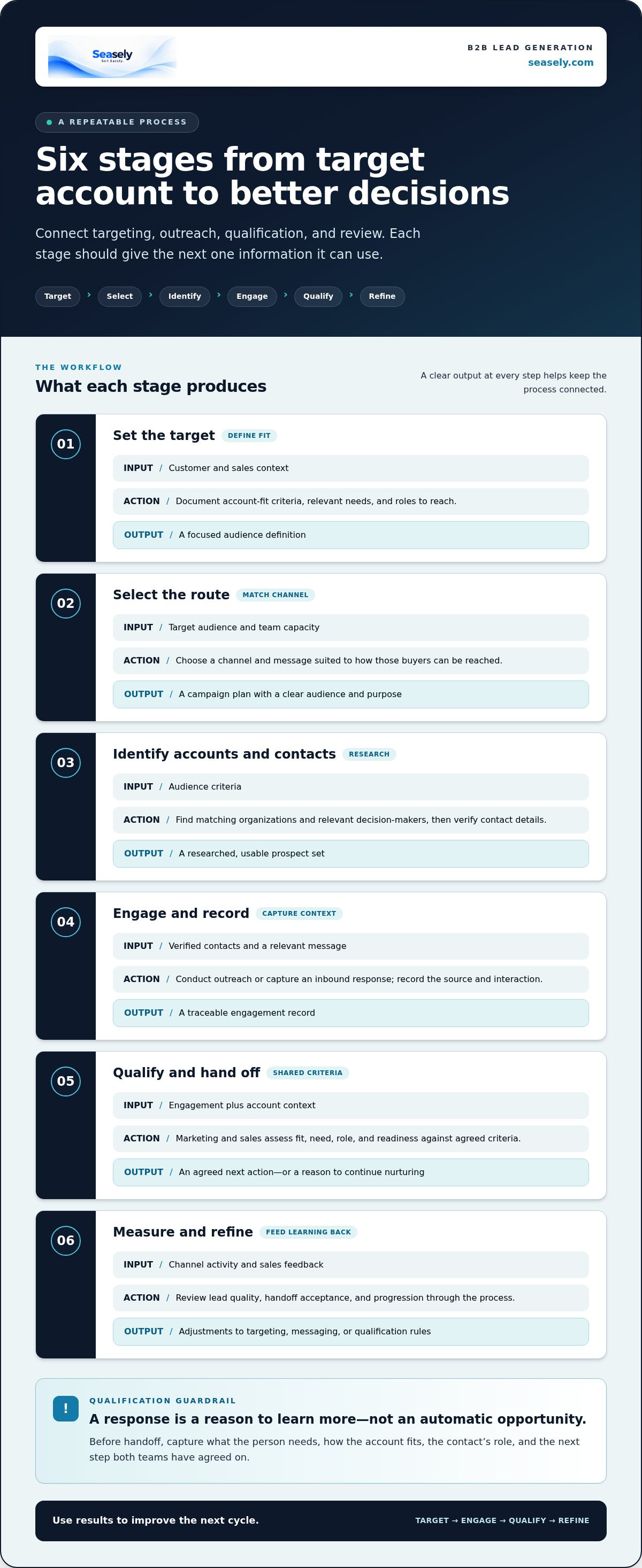
A workable process connects targeting, outreach, qualification, and review. Each stage should produce information the next stage can use. In b2b lead generation, that structure helps teams distinguish a useful response from a record that has simply entered a database.
Start with an ideal customer profile and buying group
Define the account characteristics that align with your offer and sales capacity. Consider firmographics such as industry, company size, and location, then add the business needs your solution addresses. Look for observable signals, such as relevant growth or operational changes, without treating a signal as proof of purchase intent. Map likely decision-makers and influencers. One contact’s interest may open a conversation, but it doesn’t represent the entire account.
Start with specific criteria and apply them consistently. The Modern B2B Lead Generation Strategies discussion also emphasizes building outreach around the buyer, rather than relying on a one-size-fits-all approach.
- Set the target. Input: customer and sales context. Action: document account-fit criteria, relevant needs, and roles to reach. Output: a focused audience definition.
- Select the route. Input: target audience and team capacity. Action: choose a channel and message suited to how those buyers can be reached. Output: a campaign plan with a clear audience and purpose.
- Identify accounts and contacts. Input: audience criteria. Action: find matching organizations and relevant decision-makers, then verify contact details. Output: a researched, usable prospect set.
- Engage and record. Input: verified contacts and a relevant message. Action: conduct outreach or capture an inbound response, recording the source and interaction. Output: a traceable engagement record.
- Qualify and hand off. Input: engagement plus account context. Action: marketing and sales assess fit, need, role, and readiness against shared criteria. Output: an agreed next action, or a reason to continue nurturing.
- Measure and refine. Input: channel activity and sales feedback. Action: review lead quality, handoff acceptance, and progression through the process. Output: adjustments to targeting, messaging, or qualification rules.
Move from first interaction to qualified opportunity
A response or form submission is a reason to learn more, not an automatic opportunity. Before handoff, capture what the person needs, how the account fits, the contact’s role, and the next step both teams have agreed on. Sales should give clear feedback when a handoff is premature or missing context. Marketing can use it to adjust criteria and targeting. A lead generation process becomes repeatable when every handoff produces feedback that improves the next cycle.
Automation can support defined steps such as discovering target companies, qualifying accounts, verifying decision-maker contacts, and sending personalized email. Seasely’s AI-powered outbound sales platform brings these tasks into an outbound workflow that can be optimized over time.
Which B2B Lead Generation Channels Fit Your Buyers?
The right channel depends on how buyers research, where your team can reach them, what your offer requires, and how much time and effort you can sustain. Inbound channels help buyers discover you as they explore a need. Outbound channels let your team initiate contact with selected accounts. Neither approach is a complete system on its own. For b2b lead generation, compare channels by buyer intent, time horizon, control, and operational effort, then test a focused mix.
- Content and search: Educational resources can attract buyers researching a problem. They build visibility over time, but require useful content and ongoing work.
- Events: In-person or virtual events create direct interaction around a shared topic. They can support deeper conversations, though planning and attendance take team effort.
- Referrals: Introductions from customers or partners can connect you with relevant accounts. The channel depends on relationships and is less directly controlled by a campaign.
- Paid campaigns: Ads can put an offer in front of a defined audience and give teams control over campaign parameters. They require budget and active performance review.
- Targeted outbound: Personalized outreach can reach selected accounts before they submit an inquiry. It gives teams more control over whom they approach, but relies on good research, relevant messaging, and reliable contact details.
When should a team use inbound lead generation?
Use inbound when buyers are likely to seek information while exploring a problem or evaluating possible approaches. Search visibility, practical guides, educational resources, events, and referrals can help them discover and assess your business. These routes often take time to establish, and the team has less control over when a buyer responds. Inbound works best when you can maintain helpful experiences and follow up on interest consistently.
When can outbound lead generation support demand creation?
Outbound can help when you know which accounts are relevant but can’t rely on those buyers to find you first. Start with account fit, identify and verify appropriate decision-maker contacts, then tailor outreach to a credible business need. A large contact list alone isn’t a strategy. Targeted outbound can complement content, events, and other marketing by creating a direct route to selected buyers, rather than replacing every channel.
Choose a small number of channels you can execute and evaluate well. For example, pair a useful resource that supports buyer research with carefully targeted outbound to accounts that match your criteria. A team with strong partner relationships might test referrals; a team with a focused event topic might use event follow-up alongside regular outreach. The mix should reflect your audience’s access points and your capacity to create, manage, and follow up on activity.
Run each test with a clear audience, offer, and measurement plan. Compare the quality of responses and account fit, not just clicks, registrations, or message volume. Keep what produces relevant engagement and sales conversations; adjust or pause channels that consume effort without useful signals. A focused test makes channel choices easier to evaluate and refine.
How Can You Qualify B2B Leads and Measure Quality?
A lead can match your target profile and still be a poor fit for sales follow-up. To qualify consistently, assess distinct signals instead of relying on one score or action. Strong b2b lead generation connects those signals to shared criteria, then checks whether qualified leads progress through the sales process.
- Fit: Does the account match relevant firmographic criteria, and does its business context align with the problem your offer addresses?
- Intent: Is there evidence of a relevant need or an active evaluation? Treat this as a clue to investigate, not a conclusion.
- Engagement: Has the person taken a meaningful action, such as asking a relevant question or responding to outreach?
- Contactability: Is the contact information usable, and does the person’s role make them relevant to the conversation?
What signals indicate a lead is worth a sales follow-up?
Look at account fit, need, role, timing, and engagement together. A relevant decision-maker at a well-matched company who describes a current challenge may merit a conversation. A single content download or email open is weaker evidence: it may reflect early research, incidental activity, or automated email processing. Record what supports the qualification decision, such as the account criteria met, the stated need, and the response received. That evidence helps sales assess the handoff and gives marketing something specific to review later.
Which measures help teams improve lead generation?
Agree on qualification rules before comparing campaigns. Marketing and sales should define what qualifies for handoff, what information must be included, and what counts as an accepted sales conversation. Keep the criteria practical and specific to your buying process. Review whether sales accepts leads and why it rejects them. Recurring reasons can reveal a gap in account targeting, qualification, or the handoff itself.
Track movement across stages rather than treating activity as the result. Useful measures include responses or conversions, qualified conversations, accepted handoffs, and opportunities created. Add channel contribution and disqualification reasons to the review. Interpret each measure in context: a channel may generate fewer responses but better-fit accounts, while another may create engagement that rarely advances. There is no single benchmark that fits every team, offer, or sales cycle.
Contact-data quality affects whether outreach reaches the intended person and whether the team can interpret its results. Review accuracy and relevance as part of qualification, and use a B2B sales email verification guide to support consistent checks. Seasely combines target-company qualification, decision-maker email verification, personalized email sending, and workflow optimization for outbound teams. Explore Seasely’s outbound sales platform to support a more structured approach to prospecting and contact quality.
How Can Teams Build a Repeatable B2B Lead Generation System?
A repeatable system turns campaign activity into a cycle the team can inspect and improve. Keep the setup focused: choose an objective, define who qualifies, run a channel with a clear plan, then review what happened. This gives marketing and sales a shared operating rhythm without assuming that automation or more activity will produce a particular business result.
- Set a goal. Choose an outcome the team can track, such as generating qualified conversations with a defined account segment. Make the goal specific enough to guide channel and resource decisions.
- Define criteria. Document target-company fit, relevant roles, qualification signals, and what information sales needs at handoff. Agree on the criteria before launching so campaign results have a consistent standard.
- Select a channel. Start with a channel your buyers can access and your team can execute well. Set the audience, offer, message, and review period before activity begins.
- Review results. Look beyond activity totals. Assess response quality, fit, sales feedback, and movement to the next stage. Record where the process breaks down, such as poor-fit accounts or unusable contact details.
- Refine the next cycle. Use what the team learned to adjust one or more elements, such as targeting criteria, message relevance, or channel choice. Keep changes traceable so you can tell what influenced later results.
Where can automation support the lead generation workflow?
Automation can reduce repetitive work after the team defines its audience and qualification rules. Tools can discover target companies, assess them against set criteria, identify decision-makers, and verify their email addresses. Verified contacts provide a more reliable basis for outbound activity, while personalized automated sending helps execute a defined campaign. Human review still matters: teams need to judge account fit, confirm that the message is relevant, and learn from replies and sales feedback. Automation supports execution; it doesn’t guarantee revenue.
How does Seasely fit into a broader B2B system?
Seasely is an AI-powered outbound sales platform for B2B teams. It connects target-company discovery and qualification with decision-maker email verification, personalized automated sending, and workflow optimization. This supports the outbound part of a broader system, while marketing and sales set criteria, review responses, and improve the process. Use an AI outbound sales platform workflow guide to map how each stage fits your team’s current process.
Keep the operating loop simple: define, execute, review, refine. As the process becomes clearer, automation can handle repeatable discovery, verification, and sending tasks without replacing the judgment that keeps targeting and messaging relevant. To explore how these capabilities fit an outbound workflow, visit the Seasely outbound platform.
Make the Next Campaign a Clear Test
Your next step doesn’t need to be a full-scale redesign. Choose one audience, one channel, and one result to learn from. Keep the test narrow enough to review, then use what you learn to shape the next cycle. That discipline gives b2b lead generation a practical direction and helps teams improve without adding complexity for its own sake.
For outbound execution, Seasely connects target-company discovery and qualification with verified decision-maker email addresses and personalized email sending. Its workflows can be optimized over time, while your team stays focused on audience fit, message relevance, and decisions that require human judgment.
Explore the Seasely outbound platform to support a structured outbound workflow. Start with a clear target and a manageable test, then build from what the results teach you. A steady process gives your team a sound basis for the next move.
Frequently Asked Questions
How long does B2B lead generation take to produce useful pipeline?
There’s no fixed timeline for B2B lead generation to produce useful pipeline. Timing depends on the audience, offer, channel, sales cycle, and qualification criteria. Early activity, such as replies or content engagement, is different from a qualified opportunity, and neither is the same as closed business. Set review intervals that match your sales cycle. Use observed progression to adjust expectations and execution instead of relying on a promised timeframe.
How many B2B leads should a company generate each month?
There’s no universal monthly lead target. The right number depends on conversion rates, deal size, sales capacity, and pipeline goals. Work backward from the opportunities your team needs, using your own historical conversion data to estimate how much qualified interest may be required. Then check whether sales can follow up effectively. Track fit and progression alongside volume, so a rising lead count doesn’t become the only measure of success.
Can B2B lead generation work without paid advertising?
Yes. Teams can attract or reach potential buyers through educational content, organic search, referrals, events, and targeted outbound without buying ads. Each channel still requires time and suitable execution. Search depends on useful information buyers can find, referrals depend on relevant introductions, and outbound depends on thoughtful targeting. Choose channels based on how your audience discovers and evaluates solutions, then assess qualified engagement before expanding the mix.
Is buying a contact list the same as B2B lead generation?
No. Buying contact data provides records, but it doesn’t establish account fit, confirm a relevant need, or create a useful next step. The information may help with research, but it doesn’t prove buyer intent or guarantee that details are accurate. Build a process to assess relevance, verify contact information, and decide why a person should receive outreach. Keep targeting focused and use responsible outreach practices that respect recipients’ context and preferences.
What should a team do when sales rejects most generated leads?
Start by reviewing rejection reasons with sales and grouping them by account fit, role, need, timing, or data quality. Compare those patterns with the criteria marketing used and the sources that generated the leads. A rejection may point to a targeting mismatch, incomplete context, or a different sales-stage expectation. Agree on any criteria changes, document them, and monitor the next cohort. Don’t assume every rejection reflects a marketing failure.
Can AI replace human judgment in B2B lead generation?
No. AI can support repetitive research, qualification workflows, personalization, and campaign execution, but people still need to define account fit, review context, and interpret responses. The right division depends on the workflow and the cost of acting on a poor assumption. For example, automate routine information gathering, then have the team assess whether the account and message make sense. Use automation to organize work, not to assume buyer interest or promise sales results.


