

What if low reply rates aren’t a copy problem? B2B email outreach mistakes often start earlier in the workflow, with weak targeting, outdated contact data, or unclear campaign goals. Sending regularly while getting few relevant replies is frustrating, especially when it’s hard to tell whether targeting, messaging, deliverability, or follow-up needs attention.
It’s tempting to respond with disconnected fixes: rewrite the subject line, send more emails, or add another follow-up. But those changes won’t solve a process that isn’t built around the right prospects and a relevant reason to contact them. Scaling too quickly can also put sender reputation and prospect trust at risk.
This article separates common outreach myths from the operational mistakes that undermine campaigns. Use the practical checks to improve targeting, contact-data quality, message relevance, and follow-up. You’ll also learn how to review campaign signals and make focused changes, so each adjustment addresses a likely cause rather than masking a symptom.
Key Takeaways
- Diagnose B2B email outreach mistakes across the full outbound process, not just in the wording of a single email.
- Trace how broad segments and poor contact selection can make even polished messages miss the mark.
- Separate useful personalization, sound sending setup, and purposeful follow-ups from advice that treats them as quick fixes.
- Use an ordered audit to spot observable issues in audience fit, contact quality, message relevance, sending setup, and campaign review.
- See how Seasely coordinates company discovery, qualification, verified decision-maker details, scheduled outreach, and campaign optimization.
B2B Email Outreach Mistakes Start with the Wrong Assumptions
Low reply rates don’t point to one cause. A message may need work, but the issue could also be the audience definition, contact data, sending setup, or campaign review. Changing copy before checking those inputs can leave the real problem untouched.
This section covers B2B outbound email from target selection through campaign review. The goal is to separate familiar myths from the operational choices that shape relevance. Email marketing includes many uses of email, but outbound campaigns still depend on selecting appropriate business prospects and giving each a clear reason to engage.
An outreach mistake is a break in the workflow that disconnects the right prospect from a relevant message and a responsible follow-up. This framing helps teams identify what needs attention before they change activity levels or rebuild a campaign. No single adjustment guarantees results.
Myth: More volume automatically creates more opportunities
Increasing sends can feel like the quickest way to improve the odds. But more messages won’t make an unsuitable company a better prospect or clarify an offer that doesn’t fit its needs. If a list includes businesses outside the target market, higher volume repeats the mismatch at a larger scale.
Volume can also amplify weak inputs. Outdated addresses, poorly defined segments, and inconsistent sending practices affect more recipients as activity grows. Diagnose first: check whether selected companies fit the target, whether the contacts are appropriate, and whether the campaign is reaching its intended audience. Increase activity only when those inputs are understood and controlled.
Myth: A good template works for every prospect
A reusable structure can make campaigns easier to manage. A fixed pitch, however, can’t account for every prospect’s role, company fit, or likely need. A finance leader and an operations manager may work at similar companies but care about different problems. Giving both the same generic benefit can make the message feel disconnected.
Keep the structure, but adapt the reasoning. Use relevant company or role context to explain why the offer may matter to that recipient. A name or company token alone is superficial personalization; it doesn’t establish fit. Effective personalization connects useful context to a clear message while keeping the workflow consistent and reviewable.
Use these myths as diagnostic prompts, not shortcuts. Before sending more or swapping templates, trace the campaign from audience choice to message and review. That sequence makes it easier to find where relevance breaks down and choose a focused correction.
How B2B Outreach Mistakes Compound Across Targeting and Data
Campaign relevance is built in stages. First define the target market, then select companies that fit it, then identify contacts whose roles connect to the likely need. A gap at any stage affects the next one. If the market definition is too broad, company selection becomes inconsistent. If company fit is weak, choosing a contact by title alone won’t make the outreach relevant.
This sequence helps prioritize B2B email outreach mistakes. Trace the workflow from the first qualification decision instead of treating segmentation, data quality, and copy as unrelated checklist items. A polished message can’t compensate for a prospect who doesn’t fit.
Mistake: Treating a broad audience as one segment
Before drafting, group companies by meaningful fit criteria, such as business model, operational context, or the problem your offer addresses. A job title can help identify a contact, but it doesn’t prove that the account is a match or that the person owns the relevant need.
For example, a defined segment might include regional software firms with a particular sales structure. An undifferentiated list of anyone with a “sales” title could include companies with very different needs. The first segment gives the message a clearer context; the second forces one pitch to cover too many situations.
Mistake: Sending before checking prospect data
Even a well-chosen account can lead to a poor send if its contact record is stale or incomplete. An outdated address may not reach the person. A role change can send a relevant offer to the wrong recipient, while missing company context makes it harder to explain why the outreach matters.
Make data review a defined step before scheduling. Check that the company still fits, the contact’s role appears relevant, and the email address has been verified. Verification helps assess contact-data quality, but it doesn’t guarantee inbox placement. These B2B sales email verification techniques can help frame that check as part of a broader process.
Qualification selects a plausible account, verified details connect the message to the right person, and relevant outreach gives that person a reason to read. Treat these as linked controls. If a campaign underperforms, identify the earliest step that failed before rewriting every message or expanding the list.
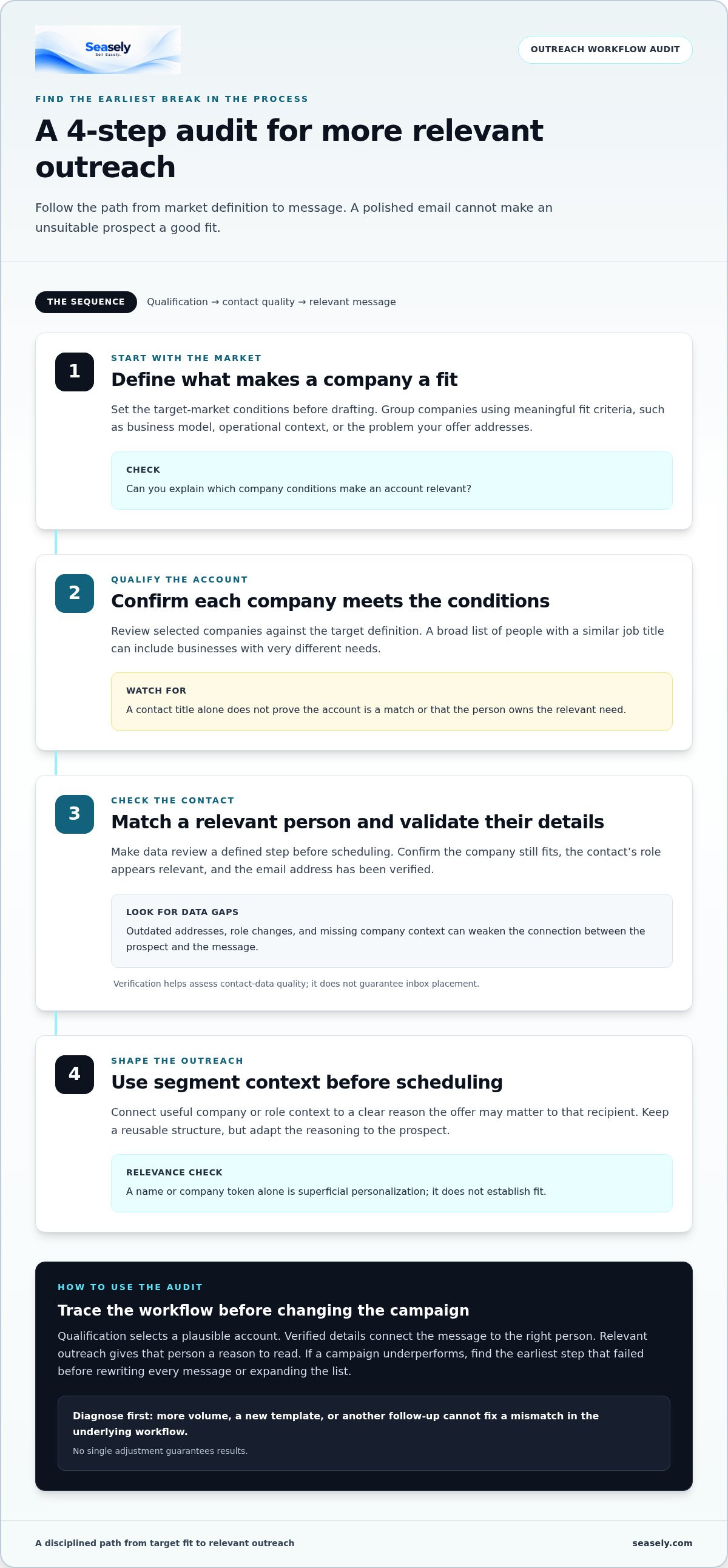
A practical review can follow this order:
- Define the market and the conditions that make a company a fit.
- Confirm each selected company meets those conditions.
- Match a relevant contact to the account and validate their details.
- Use the segment context to shape the message before scheduling.
For teams coordinating these steps, Seasely’s prospect discovery and qualification workflow connects target-company selection with verified decision-maker contact details. Automation organizes the handoffs, while the team applies judgment to account fit and message relevance.
Personalization, Deliverability, and Follow-Ups: Where Common Advice Goes Wrong
Personalization, authentication, and follow-ups all support an outreach workflow, but none can compensate for poor audience fit. Treating them as isolated fixes can hide the underlying issue. Use this myth-versus-reality view to check what each step can actually do.
| Myth | Reality |
|---|---|
| Adding a first name makes an email personal. | Useful personalization connects the account, recipient’s responsibilities, and a credible reason to write. |
| Authentication guarantees inbox placement. | SPF, DKIM, and DMARC help verify and align sender identity. They don’t control every factor that affects delivery. |
| More follow-ups will eventually get a reply. | A follow-up should add context or clarify value. Repeating the same pitch can add noise instead. |
Mistake: Confusing personalization with inserting a first name
A greeting with a first name is a merge field, not proof that the message fits. Contextual relevance requires a link between the account’s situation, the recipient’s responsibilities, and the reason for contacting them. A message to an operations leader, for example, should make sense for that role and company, not just contain their name.
AI can help produce or adapt wording, but the quality depends on the information it receives. Incorrect account details can make a polished message confidently wrong. Check the source context and review the result before sending. Personalization is useful when it explains the fit, not when it decorates a generic offer.
Mistake: Treating authentication or follow-ups as magic fixes
Authentication is a foundational part of sender configuration. SPF identifies which sending systems are authorized for a domain. DKIM adds a cryptographic signature that receiving systems can use to check message integrity and domain association. DMARC tells receiving systems how to handle messages that fail authentication checks and provides reporting. Correct setup supports trust in sender identity, but it doesn’t guarantee inbox placement or replies.
Follow-ups need the same discipline. Give each message a clear purpose: add a useful detail, address a likely question, or restate the value in a more relevant way. Avoid stacking competing calls to action. One clear next step is easier to understand than several requests in the same email. Choose timing and whether to continue based on campaign context rather than applying a fixed rule to every prospect.
These B2B email outreach mistakes are easier to diagnose when each component has a distinct job: personalization establishes relevance, authentication supports sender identification, and follow-up advances the conversation. Review them as connected parts of the workflow, not interchangeable levers.
For teams shaping the structure and logic of a multi-message campaign, automated email sequences offer a useful way to think about sequence design. Keep each step aligned with the prospect and the purpose of the outreach.
A Practical Audit for Finding and Fixing B2B Email Outreach Mistakes
When a campaign stalls, change the earliest weak input you can identify, then review what happens. This ordered audit helps pinpoint B2B email outreach mistakes without changing the audience, copy, and sending process all at once. For each step, record the warning sign and the correction you’ll test.
- Audience fit. Warning sign: The selected companies share little beyond a broad industry label. Correction: Recheck the segment against the problem your offer addresses, and remove accounts that don’t fit the intended profile.
- Contact quality. Warning sign: Records contain outdated addresses, mismatched roles, or too little company context to explain the contact’s relevance. Correction: Verify the address and role, then complete or exclude records that can’t support a relevant message.
- Message relevance. Warning sign: The email could be sent to any company or role without changing its main point. Correction: Connect the offer to a specific account context and give the recipient one clear next step.
- Sending setup. Warning sign: Authentication settings or sender details haven’t been reviewed, or sending activity has changed without a corresponding check. Correction: Review sender configuration and the sending process before adjusting campaign volume.
- Campaign review. Warning sign: Decisions rely on a single overall metric or an impression of how the campaign performed. Correction: Review replies, bounces, and engagement trends by segment and message variation, then document the next adjustment.
Diagnose the workflow before increasing volume, because sending more can amplify a weak input instead of correcting it. Higher activity won’t reveal whether the problem lies in account fit, contact accuracy, message relevance, or sending setup.
Check the inputs before changing the message
Start with the intended company segment and write down why each account belongs in it. Then inspect the contact’s role, address quality, and available company context. If those checks hold, review whether the message clearly connects the account to the offer. Where practical, change one meaningful input at a time so the next review can show what changed alongside the result.
Use campaign signals to choose the next correction
Bounces and other delivery signals point to different issues than replies or engagement patterns. Don’t treat a bounce as evidence that the copy failed, or a lack of replies as proof that the sender setup is wrong. Compare outcomes across segments and message variations, and interpret each signal in context rather than relying on an unsupported benchmark threshold.
Keep a simple change log: note the segment, the adjustment, and the observation that prompted it. That record turns campaign review into a learning loop. If a segment produces bounces, check its contact data. If delivery appears stable but responses vary by message, inspect the relevance and clarity of the copy. Avoid changing several variables at once, since that makes cause and effect harder to see.
To coordinate prospect selection, personalized outreach, and campaign review in one workflow, Explore a more coordinated outbound workflow.
Build a More Disciplined Outreach Workflow with Seasely
Automation is most useful when it connects the steps that make outreach relevant. It can coordinate company discovery, qualification, contact details, personalized scheduled emails, and campaign review. It can’t replace sound targeting or judgment. Seasely helps teams address B2B email outreach mistakes by bringing these workflow steps together, while the decisions behind the campaign still matter.
Connect prospect discovery, qualification, and outreach
Start by identifying companies that fit the market and the problem your offer addresses. Qualification gives each account a reason to enter the campaign instead of relying on a broad list. Verified decision-maker email addresses provide better contact inputs and help connect the outreach to a person whose role is relevant.
Personalization should draw only on useful prospect context. If a company’s fit or a contact’s responsibilities are unclear, don’t fill the gap with an invented assumption. Use what’s known to shape a message that explains why you’re writing, then review it for accuracy before scheduling. Seasely supports this workflow with automated target-company discovery and qualification, verified decision-maker details, and personalized scheduled outreach.
This order matters. If the account doesn’t fit, adding contact data won’t make it a good prospect. If the contact is wrong, a tailored message may still miss its intended reader. Coordinating qualification and contact selection before sending helps teams preserve a clear reason for each email.
Keep the workflow measurable and adjustable
Scheduled sending is an execution step, not the end of the process. After a campaign runs, review its signals by segment and message variation. Look at replies, bounces, and engagement trends in context. Then identify which workflow step those observations may point to and make a focused adjustment. For example, a pattern of bounces may call for reviewing contact records, while differences in responses across message variations may prompt a closer look at relevance.
Keep a record of what changed and why. That creates a usable feedback loop: qualify, prepare accurate contacts, personalize, schedule, review, and refine. Automation can make those handoffs more consistent, while people remain responsible for audience fit, context, and editorial judgment. For broader considerations when assessing how a platform supports the full process, see this guide to AI outbound sales platform evaluation.
No software can guarantee sales or revenue outcomes. Seasely coordinates outbound workflow steps, while campaign performance still depends on the choices teams make and what they learn from review. Explore Seasely’s AI outbound sales platform to see how discovery, qualification, scheduled outreach, and campaign optimization fit into one process.
Make Your Next Campaign a More Useful Test
The next step isn’t to overhaul every campaign at once. Choose one part of the workflow to improve, define what you’ll observe, and set a clear review point. That turns B2B email outreach mistakes into signals for better decisions, rather than reasons to make another untested tweak.
Keep the process steady: make a deliberate adjustment, review the response in context, and use what you learn to guide the next one. Automation can help coordinate those steps, but it can’t replace sound judgment or guarantee sales and revenue outcomes. The value comes from a workflow your team can inspect and refine.
When you’re ready to connect campaign execution with ongoing optimization, Explore Seasely’s AI outbound sales platform. Start with a process your team can measure, then improve it with care.
Frequently Asked Questions
Is personalization the most important factor in B2B email outreach?
Personalization matters when it reflects genuine account and recipient relevance, but it isn’t the only factor. Mentioning a recent company initiative can help explain why you’re writing; inserting a first name into a message that doesn’t fit the recipient is superficial. Personalization also can’t correct an inaccurate address or an unclear offer. If replies are low, review the full campaign, including its audience, contact records, value proposition, and message.
Can automated B2B email outreach damage a sender’s reputation?
Yes. Automation can contribute to risk if it enables poor targeting, questionable contact data, unsuitable sending practices, or weak domain configuration at scale. The software itself doesn’t determine the outcome. Use a controlled process: maintain accurate recipient records, review sending behavior, and configure appropriate authentication. Monitor campaign signals and adjust if problems appear. No platform or individual setting can guarantee inbox placement or prevent every issue that may affect sender reputation.
How many follow-up emails should a B2B outreach sequence include?
There’s no universally correct number for every audience, offer, and sales cycle. Give each message a clear purpose, such as answering a likely question or adding context, and consider whether the prospect has had a reasonable chance to respond. Make the next step clear without pressuring the recipient. Stop the sequence when someone replies or indicates they don’t want further contact, and use campaign observations to refine future sequences.
What should I check first when a B2B outreach campaign gets few replies?
Start with fit: check whether the selected companies and recipients are plausible matches for the offer. Then inspect address accuracy and whether the message gives that audience a clear reason to respond. Compare delivery signals, such as bounces, with response signals, such as replies. These B2B email outreach mistakes can have different causes. Change one meaningful variable at a time, record the result, and avoid increasing volume before you know what needs attention.
Does email verification guarantee that a message will reach the inbox?
No. Verification helps assess whether an email address appears usable, but it can’t guarantee successful delivery or inbox placement. Results may also depend on sender configuration, recipient systems, message content, and sending behavior. Treat verification as one data-quality control, not a complete deliverability solution. For example, a checked address may still belong to someone who has changed roles, so confirm that the contact remains relevant before building a campaign around it.
Should B2B teams use the same outreach message for every industry?
A reusable structure can help a team work consistently, but the same message may overlook differences in company context, recipient responsibilities, and likely business needs. Keep the core structure if it helps, then adapt the reason for writing to each relevant segment. For example, explain the same offer through the operational issue it addresses for a specific audience. Use details the team can support, and avoid presenting assumptions as facts.
Is a low open rate enough to prove that an outreach email is failing?
No. An open rate alone can’t establish whether a campaign is working, and tracking limitations can make the signal unreliable. Privacy features may register opens without a person actively reading the message. Consider delivery indicators, replies, positive responses, and the campaign’s purpose together. Compare similar segments and review patterns over time. A single low reading may be a reason to investigate, but it isn’t enough to identify the cause or choose a fix.


